I had the wonderful pleasure of spending a day watching Tony Award winning Lighting Designer, Don Holder, tech the production of Oleanna by David Mamet, Directed by Doug Hughes, starring Bill Pullman and Julia Stiles at the Golden Theater in New York!!!
It was a wonderful opportunity to re-introduce myself to Mr. Holder, watch him work hard and fast, as he moved from cue to cue adding, filling in, removing, adjusting, and cleaning up the already quite neat and tidy design that he had created for the production. Having the opportunity to listen and watch him cue the show, while watching the board-op type key strokes, and seeing Mr. Holder’s associate and assistant working right along side him was a wonderful treat that I will cherish for many years. We even got to go out to dinner with him and ask him a variety of questions about the production and how he works with students, young designers, and others in the field. I can’t wait to come down next month for a chance to see him work on Ragtime. (I will also be taking that opportunity to watch my Sound Design professor Rob Kaplowitz work the acclaimed production of FELA!)
I owe a deep thanks and overwhelming gratitude to Traci Klainer for making this day possible! It is truly an opportunity that not many young designers get to have, and I am so appreciative of the opportunity to learn so much in such a short period of time.
Not only did she set us up to watch Mr. Holder, but she was able to bring Chris Darland from Artec Consultants, Jason Lyons who created the lighting design for Rock of Ages currently playing on Broadway, Brian MacDevitt who recently won a Tony award for best lighting design of a play "Joe Turners Come and Gone", and many other folks to whom I can’t wait to interact with more.
So, thank you very much Traci for a wonderful day, and I look forward to many more in the near future.
Showing posts with label Sound. Show all posts
Showing posts with label Sound. Show all posts
Sunday, September 27, 2009

Friday, September 18, 2009
Marta Sound Design
Last semester I took an introduction to Sound Design class. We discussed many ways to begin hearing sound, our environment, and how to re-create or create a new environment for the theater. One of the exercises during our first cuing session was to find our loudest sound, and then begin to fine tune that through the speakers. After we set the volume for that cue, the next step was to find our quietest sound, and then begin to fine tune that through the speakers. In loo of that exercise, I began my research for Marta the Divine by beginning to acquire materials that I believe help to create the loudest sound for the production. By doing this, I am also testing out my fellow collaborators sensibilities toward how they are hearing the world of the play.
Here are a few links to the sounds I have found for a bull fight and a some responses to those sound resources from my colleagues:
Raging bull--I found that I really want to begin to develop a sound environment for this production. I don't only want to have sound cues for special moments in the play, but rather, I would like the audience to hear this world as often as they are seeing it. In other words, an audience must always see the environment to understand the play, they must also hear the environment to understand the play. Just as it is always a challenge for a lighting designer to create a dim or dark look on stage and still see the actors...it is also a challenge for a sound designer to create a loud scene, yet still be able to hear the actors. This is my challenge and I can't wait to meet it in the theater.
Battle of the Bull--One thing that Harley pointed out to me, which I am very intrigued by is that he said (to paraphrase), the bull fights during the period of Marta would not have actually been in a colosium the way we imagine a modern bull fight to be. It would be more like the running of the bulls in the streets. In other words, they were rougher. I imagine they were much more dangerous and deadly, yet I can't help but notice that the screams were much louder in these videos when the bull fighter was being malled by the bull (it may be a sound edit, but none the less interesting to see).
Bull fighting midget--I like this one the most because it is comic to me. The sound the tiny voices mixed with the "manliest" of sports.
Bull fight introduction--Finally, it was nice to hear that people could really relate to these sounds, and yet I love that Gina mentioned she wonders what happened to my original thoughts about dryness and cactus and dirt roads, because she can't hear that in the clips that I played. I don't want the audience to be taken away from that environment (if that is the environment we create for this scene), and so it is my job to find that sound that keeps us in the bull fight on the dry road as we pass a cactus, and yet still create the awe, wonder, danger, and urgency in the sound we hear.
I am so very excited to see how this continues to develop!
Here are a few links to the sounds I have found for a bull fight and a some responses to those sound resources from my colleagues:
Raging bull--I found that I really want to begin to develop a sound environment for this production. I don't only want to have sound cues for special moments in the play, but rather, I would like the audience to hear this world as often as they are seeing it. In other words, an audience must always see the environment to understand the play, they must also hear the environment to understand the play. Just as it is always a challenge for a lighting designer to create a dim or dark look on stage and still see the actors...it is also a challenge for a sound designer to create a loud scene, yet still be able to hear the actors. This is my challenge and I can't wait to meet it in the theater.
Battle of the Bull--One thing that Harley pointed out to me, which I am very intrigued by is that he said (to paraphrase), the bull fights during the period of Marta would not have actually been in a colosium the way we imagine a modern bull fight to be. It would be more like the running of the bulls in the streets. In other words, they were rougher. I imagine they were much more dangerous and deadly, yet I can't help but notice that the screams were much louder in these videos when the bull fighter was being malled by the bull (it may be a sound edit, but none the less interesting to see).
Bull fighting midget--I like this one the most because it is comic to me. The sound the tiny voices mixed with the "manliest" of sports.
Bull fight introduction--Finally, it was nice to hear that people could really relate to these sounds, and yet I love that Gina mentioned she wonders what happened to my original thoughts about dryness and cactus and dirt roads, because she can't hear that in the clips that I played. I don't want the audience to be taken away from that environment (if that is the environment we create for this scene), and so it is my job to find that sound that keeps us in the bull fight on the dry road as we pass a cactus, and yet still create the awe, wonder, danger, and urgency in the sound we hear.
I am so very excited to see how this continues to develop!
Tuesday, September 1, 2009
Curiosity Continues to Develop
I am so amazed about how excited my team members are for this production. Seeing ideas bounce in the air and fly around the room while composed music is being played, just makes me smile. I wish I could share this sound with you all, but since I can't just walk around clicking your tongue, purring, bopping, and popping...whoop, hoop and hauler...
Check it out the notes here... Curiosity !!!
Check it out the notes here... Curiosity !!!
Tuesday, July 14, 2009
Puppetry: A World History

I just read the first chapter of Eileen Blumenthal's book, Puppetry: A World History. I am learning that puppetry is truly an art form that is as old as time. It has been used to express all kinds of stories from children stories to political propaganda, Shakespeare, religion, and tales of a comic and/or tragic nature. What kind of puppetry do you prefer? Are you more of a sock puppeteer, a string, rods, shadow, lap, or other? I tend to be more of a shadow puppet kind of guy myself.
I can't wait to see how we begin to construct our story, characters, and world. Unfortunately, I will have to wait until the class (click on Schedule of Classes p. 660) starts in September to start seeing any kind of tangible development. We are getting pieces placed together, for example, performance scenarios, music, and characters. Each week brings with it new information, new adventures, and more! Stayed tuned...
Monday, July 13, 2009
Marta the Divine
I am beginning to take notes and ask questions for our production of Marta the Divine at UMass, Amherst.
How do you decide when you have a character who could be cast as either a man or a woman? Keep in mind that the choice will change the tone and relationships in the play considerably. Do you choose based on the statement(s) that you want to make, or do you leave it to be decided by the turnout at auditions?
The opening of the play begins with a sonnet of mourning by the leading lady, and then another by her sister. Their brother has just been murdered by a man who happens to be both of the woman's lovers. I wonder how to approach the audience entrance into the theater and the opening of the play. The play as a whole is a comedy, yet this opening is very mournful and somber. Do I assist the playwright's deceptive opening and create a mournful atmosphere with the sound? Will the lighting and costume designers open the play with lighting that helps to create a somber mood/atmosphere and costumes that are worn during a time of mourning? Here are a few sound bites that inspire me for the audience entrance into the space and the first two sonnets by Marta and Lucía...
Great Thaw
Nostalgia B
(Argentina) Tango
How do you decide when you have a character who could be cast as either a man or a woman? Keep in mind that the choice will change the tone and relationships in the play considerably. Do you choose based on the statement(s) that you want to make, or do you leave it to be decided by the turnout at auditions?
The opening of the play begins with a sonnet of mourning by the leading lady, and then another by her sister. Their brother has just been murdered by a man who happens to be both of the woman's lovers. I wonder how to approach the audience entrance into the theater and the opening of the play. The play as a whole is a comedy, yet this opening is very mournful and somber. Do I assist the playwright's deceptive opening and create a mournful atmosphere with the sound? Will the lighting and costume designers open the play with lighting that helps to create a somber mood/atmosphere and costumes that are worn during a time of mourning? Here are a few sound bites that inspire me for the audience entrance into the space and the first two sonnets by Marta and Lucía...
Great Thaw
Nostalgia B
(Argentina) Tango
Thursday, March 12, 2009
Theatrical Development

Marcus Gardley
I sat in on a production meeting today for ...And Jesus Moonwalks on the Mississippi by Marcus Gardley, our faculty playwright. I had been hearing a lot of conversation about the process...lots of information, lots of technology, frustration, challenges, questions, confusions...the real problem however isn't anybody or anything that has happened, but simply the fact that nearly nobody is used to working with so many unknowns. They aren't used to experimenting with the an ever evolving set, script, and production elements. I would love to work on this project, but my faculty adviser, Penny Remsen, decided that this was too close to my cup of tea. I have worked in experimental theatre for the past 9 years at both Westmont College and Lit Moon Theatre and I need to learn some other ways of approaching the art form.
Anyway, the experimental process is really having its toll on everybody! Here's the scenario...
The set keeps changing or being adjusted (in the grande scheme of things very minor adjustments, but adjustments nonetheless), the script is still being worked as the director, performers and playwright become more familiar with the characters in relationship to the actors, we are beginning to work with projections, lighting, and sound, and the production opens April 30th (7 weeks). Plenty of time if we weren't working with so many projections with equipment that is less than unsatisfactory for the purpose, as well as, so many students, faculty, and staff who are used to having a fixed set, ideas, and purposes.
So, here's the question...At what point do you stop changing the theatrical elements and start polishing them?
My personal thought...it never stops changing until the show closes for good...experiment until you can't experiment anymore!!!
Friday, March 6, 2009
Devised Theatre
Well, we have come up with a full script. A 30 minute long journey through the birth, growth, and death of a relationship with a twist. We have been playing with multi-stable illusions...
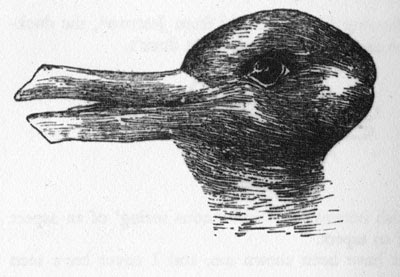
What do you see...?
This idea of seeing action and dialogue from different perspectives, stories, and/or people. I love what we have created, and I can't wait to start putting the scenic elements together with the movement and language. It is going to be a feast for lighting and sound to play with!
Here is a little taste of a movement section:
...and door-handle, with a marker. The marker drops; the child skips off.
(2)
The door, which was exacto-knifed onto the box before the start of the production, opens, and out walks a homeless man. He picks up the marker
Here is a little taste of a section of dialogue:
PSYCHIC
(looking in crystal ball)
I see…
MAN
(worried)
Is it bad?
PSYCHIC
(seeing his worry, fishing)
It’s not good, no. You’re not married?
Change the circumstance...
MAN
I see.
LOVER
Is it bad?
MAN
It’s not.
LOVER
Good. (Crosses to him)
MAN
No.
LOVER
You’re not married.
At any rate...I can't wait to keep working on the production...I am curious how many of you are working on a piece of devised theatre? or When was the last time you worked on a piece of devised theatre...?

What do you see...?
This idea of seeing action and dialogue from different perspectives, stories, and/or people. I love what we have created, and I can't wait to start putting the scenic elements together with the movement and language. It is going to be a feast for lighting and sound to play with!
Here is a little taste of a movement section:
...and door-handle, with a marker. The marker drops; the child skips off.
(2)
The door, which was exacto-knifed onto the box before the start of the production, opens, and out walks a homeless man. He picks up the marker
Here is a little taste of a section of dialogue:
PSYCHIC
(looking in crystal ball)
I see…
MAN
(worried)
Is it bad?
PSYCHIC
(seeing his worry, fishing)
It’s not good, no. You’re not married?
Change the circumstance...
MAN
I see.
LOVER
Is it bad?
MAN
It’s not.
LOVER
Good. (Crosses to him)
MAN
No.
LOVER
You’re not married.
At any rate...I can't wait to keep working on the production...I am curious how many of you are working on a piece of devised theatre? or When was the last time you worked on a piece of devised theatre...?
Tuesday, February 24, 2009
Pericles iv.
We are moving in to our first dress rehearsal tonight! I am very excited to run the show with as few stops as possible. Our Lighting designer, Thad Kramer, a 1st year graduate student at UMASS (and a fantastic designer), has been developing his ideas for several months and building cues for several days, and he finally get's to see the fruits of his labors. Although he will be making adjustments to the cues while I take notes for him, he is pretty much finished and ready to go. It is has been a wonderful experience working with Director, Shawn LaCount, a third year grad in our program at UMASS, and Artistic Director of Company One in Boston, MA. His constant communication, interaction and support during the development of the production and specifically during the technical runs, has been absolutely integral to the success of this production. I cannot say how important it is for a lighting designer to have constant interaction with the designers and especially the director. A steady flow of communication ensures that the cues being built by the lighting designer are those that have been dreamed of and blocked by the design team and performers.
So, thank you to you all for such a great experience, and I hope these next few days result in a production that excites audiences, gives joy to the cast and crew, and does justice to the artistic process!!!
Congrats to all!
So, thank you to you all for such a great experience, and I hope these next few days result in a production that excites audiences, gives joy to the cast and crew, and does justice to the artistic process!!!
Congrats to all!
Sunday, February 22, 2009
Pericles iii.
Wow! What an amazing process!! I love working on productions that require lots of communication (funny right...what show doesn't require lots of communication)...perhaps, what I ought to say is...I love working on productions where we actually do a lot of communicating! I think this production of Pericles will be a fabulous and exciting production. Lot's of promising moments and scenes. We will be adding costumes to the tech process tonight. This will add the final missing and exciting element to the production. The costumes are amazing. Heather (our third year grad student) has developed an incredible array of costumes. Somewhere near 50 costumes for 18 different actors. What a feat...and our costume shop is working hard to make this a reality. Thank you guys! Your work is deeply appreciated!!! Hurray!!! for the cast and crew of Pericles... :)
Monday, January 26, 2009
Sound Design
So, I attended my first design class at Amherst College today. It was laid back, informative, and intriguing. All the things I hope for and look for in a class. I want a chance to explore and learn at the same time. A chance to ask questions without the constant..."you can't do that"...phrase penetrating my art. Anyway, our first assignment is to record 10 sounds, but I don't have a device to record sound on: Our video camera only records video and not sound, I lost my phone today, and so what am I going to do? Rob, the instructor, offered a recording device, but made it clear that he prefers we find our own device, rather than borrow one of the available one's. He likes resourcefulness, who doesn't? At the break, I hopped on my computer and attempted to see if I could make a recording...after all, I can Skype...why not make a movie or sound recording too...Here are the fruits of my search...
We also spent the day attempting to define "music"...Here is the definition of music for our class created from the students collaborative perspective:
"An intentional or deliberate arrangement of sound and/or silence encountered by an audience over time."
What do you think? What do you consider to be music?
We also spent the day attempting to define "music"...Here is the definition of music for our class created from the students collaborative perspective:
"An intentional or deliberate arrangement of sound and/or silence encountered by an audience over time."
What do you think? What do you consider to be music?
Subscribe to:
Posts (Atom)

