Inspired by Jun'ichiro Tanizaki's In Praise of Shadows
I just finished reading Jun’ichiro Tanizaki’s In Praise of Shadows and as an exercise in light and shadows I have decided to explore my home. From room to room, I am entering it as we have it arranged now. Our kitchen has a single window open with a fluorescent light illuminating the 10’x10’ area. I move a few feet over into the dining room where a chandelier with 5 small candelabras illuminates the 10’x10’ area (As well as the light spilling and bouncing around from the kitchen into the dining area). I move another few feet into our living room where a double set of open windows illuminate the area (the light from the kitchen and dining room fades as the light from the sun over powers it). I move a few feet into the hallway where all doors leading to other rooms are open and a cool light caresses the walls, floor and ceiling. I pass into our children’s bedroom where gentle, warm sunlight filtered by a tree lightly falls through the window to the center of the room. I retrace my steps, peer into the darkened cold bathroom, and move on toward our bedroom where the blinds are closed allowing a harshly filtered light to permeate the air.
Here is what I discovered about the quality, direction, and temperature of the light:
The kitchen is practical. We can see clearly what we are cooking, cleaning, and storing, but it lacks a warmth I enjoy when I think of the love that goes into those meals.
The dining room light is unnecessary even while eating, but at night it is a different story.
As I move into the living room, I wish for the filtered light through a tree, but at this time of day it is beaming into the room with all its warmth and power. It makes reading difficult and does not offer a comfortably cool feeling that one hopes for while resting.
As I move into the hallway, I quickly breeze through as it is not pleasant in its darkness.
Then walking into the children’s room I find myself the most at ease. I feel a strong sense of pleasure. The light is filtered through a tree, falling onto the ground, then bouncing up onto the white walls and ceiling. It is cool but not cold. Warm but not hot. I enjoy looking at the things in the room. This is my ideal room with a soft, filtered light falling onto the ground, then bouncing around the room.
As I walk back toward my bedroom I pass the bathroom and wish it was inviting.
My bedroom is quiet and almost as pleasant as our children’s room. The light being filtered through the white shades is creating a much colder and harsher light. It is also constantly changing from bright to dim to dark to bright again all within the matter of seconds. This is due to the shades moving in the breeze coming from outside. This does not make for a pleasant feeling and drives me out of the room.
My experiment has proven to be quite interesting, yet I wonder what it would be like to do the same thing in the morning or evening hours. I also wonder what I would think during the heat of summer or the cold of winter. What would my preferences be for the artificial light vs. the natural sunlight?
Showing posts with label Lighting. Show all posts
Showing posts with label Lighting. Show all posts
Monday, September 27, 2010

Wednesday, June 9, 2010
Developing Creative Ideas
I have been spending a little time each day living in the world of Putnam County's 25th Annual Spelling Bee. Each day I turn another page where in my world a couple of hours has passed, while in their world, I'm lucky if 5 minutes has passed.
I am trying a new method to tracking my thoughts and notes on the production. I borrowed a format from a fellow colleague and adapted it for my own purposes. On one page, I can track the cue number, fade time, page, purpose, and placement. On another page, I can track the follow-spot cue number, fade time, page, color, purpose, and placement. On another page, I can track my notes and thoughts about why I think my choices work. Or, I can ask questions of myself or of others when the time is right. On other pages, when the time comes, I will track light groups, color palettes, moving light pre-sets, among other things.
The benefit of this new method to my old method is simple to explain. It is more detailed; in the past I would only track cue number, fade time, page, purpose, and placement. I would also write the information in a notebook to later be transferred to a computer. Now I am entering the information directly into an Excel document. This saves hours of valuable time that may be spent refining and critiquing my thoughts. Allowing me to always bring the design back to the script and determine what is relevant to the play and what is fluff. My goal is to be finished going through the script by next Wednesday when I will meet with the Music Director. I hope I will be able to present clear needs for concrete development between our departments in order to produce the best possible cohesion of lights and sound in the world of the play on stage.

Cue List Track Sheet

Follow Spot Track Sheet

Notes Track Sheet
I am trying a new method to tracking my thoughts and notes on the production. I borrowed a format from a fellow colleague and adapted it for my own purposes. On one page, I can track the cue number, fade time, page, purpose, and placement. On another page, I can track the follow-spot cue number, fade time, page, color, purpose, and placement. On another page, I can track my notes and thoughts about why I think my choices work. Or, I can ask questions of myself or of others when the time is right. On other pages, when the time comes, I will track light groups, color palettes, moving light pre-sets, among other things.
The benefit of this new method to my old method is simple to explain. It is more detailed; in the past I would only track cue number, fade time, page, purpose, and placement. I would also write the information in a notebook to later be transferred to a computer. Now I am entering the information directly into an Excel document. This saves hours of valuable time that may be spent refining and critiquing my thoughts. Allowing me to always bring the design back to the script and determine what is relevant to the play and what is fluff. My goal is to be finished going through the script by next Wednesday when I will meet with the Music Director. I hope I will be able to present clear needs for concrete development between our departments in order to produce the best possible cohesion of lights and sound in the world of the play on stage.

Cue List Track Sheet

Follow Spot Track Sheet

Notes Track Sheet
Tuesday, March 16, 2010
THE IRISH CURSE
Traci Klainer, my lighting design professor at the UMass, Amherst, invited me to observe the focus and tech for her lighting design of THE IRISH CURSE. The night before my journey down to NYC I went through a variety of lists to make sure I had everything I would need for stay. I woke up just before dawn the morning of our Spring time change and headed for the train station. On the ride down, I spent a peaceful 9o minutes updating a light plot for BARNUM: THE GREATEST SHOW ON EARTH. I think there is nothing better than spending some quiet time creating.
My journey quickly came to an end as we pulled into Grand Central Terminal. I found my way quickly to the Shuttle toward 42nd Street, and then made my way to the C train, which was an unexpected hike in the subway tunnels of NYC. Once I returned to the surface, fresh air, and some wonderful rainy sunlight, I began to make my way over to the SoHo Playhouse. Of course I walked a couple of blocks in the wrong direction :)
After a brief phone call to my wife, I ventured into the building where a busy crew was hard at work focusing, re-hanging as needed, and making the appropriate work notes for the afternoon session. This experience was particularly wonderful for me, because it allowed me the opportunity to see my professor execute two-thirds of her design. As she often tells us, 0ne-third of the design is the light plot, 0ne-third is the focus, and 0ne-third is the cuing. Watching Traci command the attention of the room as she rapidly bounced from one side of the stage to the next with her trusty magic sheet in hand was energizing and exciting. It was even better than the peaceful time I spent on the train designing my plot. Turning on lights can be so exciting, sometimes frustrating, and always illuminating :)
Once Traci hit her stride, she brought me up on stage to stand in the light as she made sure each light was accomplishing its prescribed goal. In a way, the focus is like preparing the canvas for the first attempt at creating the background for a wonderful work of art. This process was soon complete, and we all headed off in our different directions to find some much needed dinner and rest. As the sun quickly set and the night sky took over, I found myself drifting off to dreams of lights, sound, scenery, and performance. I love dreaming about work! (At least when those dreams are productive and inspiring.)
After waking up, having a wonderful conversation with my wife and children, I found my way back downtown. Upon arrival, I was quickly assigned the task of procuring a monitor for our ETC Impression light board, which had been used the day before without a monitor (since the original one was no longer working). A few blocks, a hand truck, and a couple of phone calls later we had a light board with monitor all ready to go for the first day of tech. Some last minute lighting adjustments were made, and a lunch break was in order.
Through the process of the afternoon, I was introduced to the playwright, director, sound designer, costume designer, and production staff. A wonderful group of men and women! I was particularly excited about my conversations with the playwright. We briefly spoke about a paper project I worked on with one of his plays, and the potential for working with another of his plays in the future. If this play he was speaking of is anything like SCITUATE and THE IRISH CURSE, then I am sure I am in for a wonderful and exciting ride. There are so many wonderful things about what I do for a living, and meeting exciting, creative people like Martin Casella is just one of the best!
After the day of focus, it was clear that Traci's design was simple, but not without its challenges. The theater is small, low ceilings, and most lights needed to be hung on uni-strut (not the easiest of materials to work with). Yet despite these challenges, Traci was able to shape the space with her lights in a way that created a smoothe wash of the space and drew attention to the center of the space where a majority of the action takes place. She accomplished this in such a way that one's attention would not be distracted by the host of lights hovering a mere 3 feet above the actors heads. Not a small feat to accomplish, I am quite impressed, even though I expected nothing less. Her greatest accomplishments with the simple design were the way she addressed the set so that the audience was able to become that sixth person on stage. The way Traci's light danced in the space not only invited the audience into the atmosphere created by Lauren Helpern's scenic design, but also into the world of the story being told.
Needless to say this was a very exciting couple of days for me, and I wish them nothing but joy and success with this lovely and hilarious production. If you have some free time and want to see a piece of theater, then THE IRISH CURSE would be a perfect way to spend an evening. Congratulations to the team and happy opening!!!
My journey quickly came to an end as we pulled into Grand Central Terminal. I found my way quickly to the Shuttle toward 42nd Street, and then made my way to the C train, which was an unexpected hike in the subway tunnels of NYC. Once I returned to the surface, fresh air, and some wonderful rainy sunlight, I began to make my way over to the SoHo Playhouse. Of course I walked a couple of blocks in the wrong direction :)
After a brief phone call to my wife, I ventured into the building where a busy crew was hard at work focusing, re-hanging as needed, and making the appropriate work notes for the afternoon session. This experience was particularly wonderful for me, because it allowed me the opportunity to see my professor execute two-thirds of her design. As she often tells us, 0ne-third of the design is the light plot, 0ne-third is the focus, and 0ne-third is the cuing. Watching Traci command the attention of the room as she rapidly bounced from one side of the stage to the next with her trusty magic sheet in hand was energizing and exciting. It was even better than the peaceful time I spent on the train designing my plot. Turning on lights can be so exciting, sometimes frustrating, and always illuminating :)
Once Traci hit her stride, she brought me up on stage to stand in the light as she made sure each light was accomplishing its prescribed goal. In a way, the focus is like preparing the canvas for the first attempt at creating the background for a wonderful work of art. This process was soon complete, and we all headed off in our different directions to find some much needed dinner and rest. As the sun quickly set and the night sky took over, I found myself drifting off to dreams of lights, sound, scenery, and performance. I love dreaming about work! (At least when those dreams are productive and inspiring.)
After waking up, having a wonderful conversation with my wife and children, I found my way back downtown. Upon arrival, I was quickly assigned the task of procuring a monitor for our ETC Impression light board, which had been used the day before without a monitor (since the original one was no longer working). A few blocks, a hand truck, and a couple of phone calls later we had a light board with monitor all ready to go for the first day of tech. Some last minute lighting adjustments were made, and a lunch break was in order.
Through the process of the afternoon, I was introduced to the playwright, director, sound designer, costume designer, and production staff. A wonderful group of men and women! I was particularly excited about my conversations with the playwright. We briefly spoke about a paper project I worked on with one of his plays, and the potential for working with another of his plays in the future. If this play he was speaking of is anything like SCITUATE and THE IRISH CURSE, then I am sure I am in for a wonderful and exciting ride. There are so many wonderful things about what I do for a living, and meeting exciting, creative people like Martin Casella is just one of the best!
After the day of focus, it was clear that Traci's design was simple, but not without its challenges. The theater is small, low ceilings, and most lights needed to be hung on uni-strut (not the easiest of materials to work with). Yet despite these challenges, Traci was able to shape the space with her lights in a way that created a smoothe wash of the space and drew attention to the center of the space where a majority of the action takes place. She accomplished this in such a way that one's attention would not be distracted by the host of lights hovering a mere 3 feet above the actors heads. Not a small feat to accomplish, I am quite impressed, even though I expected nothing less. Her greatest accomplishments with the simple design were the way she addressed the set so that the audience was able to become that sixth person on stage. The way Traci's light danced in the space not only invited the audience into the atmosphere created by Lauren Helpern's scenic design, but also into the world of the story being told.
Needless to say this was a very exciting couple of days for me, and I wish them nothing but joy and success with this lovely and hilarious production. If you have some free time and want to see a piece of theater, then THE IRISH CURSE would be a perfect way to spend an evening. Congratulations to the team and happy opening!!!
Thursday, December 17, 2009
Education at its Best!

Choral Ode during The Burial at Thebes
Today, I turned in my last batch of work, and another semester is concluded! As was to be expected, this past semester was the most difficult yet. With three classes and three shows, I found myself constantly spinning and moving sometimes backwards, often forwards, and always onward. I always put my best foot forward and tried my hardest at everything, and without fail, I made many mistakes (often making me look like I was putting my worst foot forward).
This semester has stretched me far beyond my abilities as a lighting designer, but more so as a person, a collaborator, and an artist. I quit bad habits like smoking. I challenged my personality by forcing myself to pause and slow down. Constantly placing my temper in check and leaving anger at the doorstep. Each day was met with challenges and on occasion my temper got the best of me. With perseverance, many opportunities to collaborate were met with exciting success. Three shows were produced and staged. Each with many exciting artistic choices that I will cherish and remember for a lifetime.
I have collected images, met some exciting and wonderful people, and began nurturing a long since desired skill as a painter and artist. I can't wait to continue developing my hand as my eye continues to see, perceive, and transform.
Many thanks go out to my advisors, professors, directors, dramaturgs, actors, and fellow designers! Without each of you beside me and in front of me, I couldn't achieve with such wonderful success the goals and dreams I have set before me. Thank you!!!
Sunday, October 4, 2009
FOUR by Christopher Shinn
This week in my Lighting Design Studio course, we are beginning to discuss Christopher Shinn's play FOUR. For the record, I think he is a fantastic playwright, and I am going to have to get a-hold of more of his work. Here are some images to get me started thinking about the world of the play...

Bright, deserted parking lot...this might be too much light, but I like the color...

Wonderful green set in front of the cool blue...

I like the green and amber set against each other as well next to the black void to the left...

Again too bright, but getting close to the television quality I want...

Movie theater parking lot...kind of an orangy, amber...
Bright, deserted parking lot...this might be too much light, but I like the color...
Wonderful green set in front of the cool blue...
I like the green and amber set against each other as well next to the black void to the left...
Again too bright, but getting close to the television quality I want...
Movie theater parking lot...kind of an orangy, amber...
Friday, October 2, 2009
Developing the Design
Yesterday, our production team met during our weekly scheduled hour. I had been anticipating this meeting with great excitement and hopes for a wonderful conversation. I got more than I bargained for...!
Last week, I had made a decision to move away from my original design ideas. I had decided not to use fluorescent lights throughout the entire space, and to only use them for the audience lighting. I was concerned that I wouldn't be able to pass them as safe, that I wouldn't have as much control of them as I would like, and that they would not be capable of being smoothly integrated into the cuing process. As a result of this decision, I designed a lighting system that would support the idea of a fluorescent lit world. I am very happy that I did this, because now that I am moving back to the fluorescent lighting idea, I have both fluorescent lights and a system that will support them. I should mention that one of my advisers couldn't have met with me at a more perfect time. She was able to encourage me and drive me forward with my design and to put my fears aside, go with my instincts, and light the world of the play.
During the meeting, I was met with encouragement to place the fluorescent lights wherever I wanted to, and that we would find the ways necessary to make them safe. I was also met with very little frustration at the idea of using them, regardless of how much control I would have of them. In fact, people were more than willing to suggest ways to paint/dress them in a way that would integrate them into the world more, and to wait and see just how much control we could achieve with them as we begin to use them in the space.
Currently, I have planned for five 8 foot fluorescents and five 4 foot fluorescents to be used in the set. I have a total of fourteen 8 foot fluorescents and seven 4 foot fluorescents to use in total.

Here is an image of the set before we make any changes...
Last night, after our production meeting the scenic designer proposed a bold change to the set that would use the fluorescents to there max. He suggested that we get rid of the current set as it exists (about 8 beams or so spread out throughout the space) and build a fluorescent light installation. I am of course very excited about this idea. I am, however, a little concerned that if we get rid of the beams entirely that we will lose much of what makes these fluorescents work so well. They work in the design because of the scenic elements that I am installing the fluorescents to. I want to attach fluorescents to the existing architecture in the theater as well as the existing beams in the set as it exists. If we don't use the beams, then I think it would be to our benefit if we stick to shaping the existing architecture. The fluorescents work best as they are, if they are highlighting edges, shapes, and actors from unnatural angles and directions.
At any rate, I am very excited about getting into the space today, focusing the rep-plot for the Curtain Theater, and then beginning to install the fluorescents in places that I think they will be most effective. Then, on Saturday morning, Dennis (scenic designer) and I will continue to explore the most effective configurations of these fluorescent lights. I can't wait to see in the full scale model where he might be thinking of placing them.
Last week, I had made a decision to move away from my original design ideas. I had decided not to use fluorescent lights throughout the entire space, and to only use them for the audience lighting. I was concerned that I wouldn't be able to pass them as safe, that I wouldn't have as much control of them as I would like, and that they would not be capable of being smoothly integrated into the cuing process. As a result of this decision, I designed a lighting system that would support the idea of a fluorescent lit world. I am very happy that I did this, because now that I am moving back to the fluorescent lighting idea, I have both fluorescent lights and a system that will support them. I should mention that one of my advisers couldn't have met with me at a more perfect time. She was able to encourage me and drive me forward with my design and to put my fears aside, go with my instincts, and light the world of the play.
During the meeting, I was met with encouragement to place the fluorescent lights wherever I wanted to, and that we would find the ways necessary to make them safe. I was also met with very little frustration at the idea of using them, regardless of how much control I would have of them. In fact, people were more than willing to suggest ways to paint/dress them in a way that would integrate them into the world more, and to wait and see just how much control we could achieve with them as we begin to use them in the space.
Currently, I have planned for five 8 foot fluorescents and five 4 foot fluorescents to be used in the set. I have a total of fourteen 8 foot fluorescents and seven 4 foot fluorescents to use in total.

Here is an image of the set before we make any changes...
Last night, after our production meeting the scenic designer proposed a bold change to the set that would use the fluorescents to there max. He suggested that we get rid of the current set as it exists (about 8 beams or so spread out throughout the space) and build a fluorescent light installation. I am of course very excited about this idea. I am, however, a little concerned that if we get rid of the beams entirely that we will lose much of what makes these fluorescents work so well. They work in the design because of the scenic elements that I am installing the fluorescents to. I want to attach fluorescents to the existing architecture in the theater as well as the existing beams in the set as it exists. If we don't use the beams, then I think it would be to our benefit if we stick to shaping the existing architecture. The fluorescents work best as they are, if they are highlighting edges, shapes, and actors from unnatural angles and directions.
At any rate, I am very excited about getting into the space today, focusing the rep-plot for the Curtain Theater, and then beginning to install the fluorescents in places that I think they will be most effective. Then, on Saturday morning, Dennis (scenic designer) and I will continue to explore the most effective configurations of these fluorescent lights. I can't wait to see in the full scale model where he might be thinking of placing them.
Sunday, September 27, 2009
Oleanna
I had the wonderful pleasure of spending a day watching Tony Award winning Lighting Designer, Don Holder, tech the production of Oleanna by David Mamet, Directed by Doug Hughes, starring Bill Pullman and Julia Stiles at the Golden Theater in New York!!!
It was a wonderful opportunity to re-introduce myself to Mr. Holder, watch him work hard and fast, as he moved from cue to cue adding, filling in, removing, adjusting, and cleaning up the already quite neat and tidy design that he had created for the production. Having the opportunity to listen and watch him cue the show, while watching the board-op type key strokes, and seeing Mr. Holder’s associate and assistant working right along side him was a wonderful treat that I will cherish for many years. We even got to go out to dinner with him and ask him a variety of questions about the production and how he works with students, young designers, and others in the field. I can’t wait to come down next month for a chance to see him work on Ragtime. (I will also be taking that opportunity to watch my Sound Design professor Rob Kaplowitz work the acclaimed production of FELA!)
I owe a deep thanks and overwhelming gratitude to Traci Klainer for making this day possible! It is truly an opportunity that not many young designers get to have, and I am so appreciative of the opportunity to learn so much in such a short period of time.
Not only did she set us up to watch Mr. Holder, but she was able to bring Chris Darland from Artec Consultants, Jason Lyons who created the lighting design for Rock of Ages currently playing on Broadway, Brian MacDevitt who recently won a Tony award for best lighting design of a play "Joe Turners Come and Gone", and many other folks to whom I can’t wait to interact with more.
So, thank you very much Traci for a wonderful day, and I look forward to many more in the near future.
It was a wonderful opportunity to re-introduce myself to Mr. Holder, watch him work hard and fast, as he moved from cue to cue adding, filling in, removing, adjusting, and cleaning up the already quite neat and tidy design that he had created for the production. Having the opportunity to listen and watch him cue the show, while watching the board-op type key strokes, and seeing Mr. Holder’s associate and assistant working right along side him was a wonderful treat that I will cherish for many years. We even got to go out to dinner with him and ask him a variety of questions about the production and how he works with students, young designers, and others in the field. I can’t wait to come down next month for a chance to see him work on Ragtime. (I will also be taking that opportunity to watch my Sound Design professor Rob Kaplowitz work the acclaimed production of FELA!)
I owe a deep thanks and overwhelming gratitude to Traci Klainer for making this day possible! It is truly an opportunity that not many young designers get to have, and I am so appreciative of the opportunity to learn so much in such a short period of time.
Not only did she set us up to watch Mr. Holder, but she was able to bring Chris Darland from Artec Consultants, Jason Lyons who created the lighting design for Rock of Ages currently playing on Broadway, Brian MacDevitt who recently won a Tony award for best lighting design of a play "Joe Turners Come and Gone", and many other folks to whom I can’t wait to interact with more.
So, thank you very much Traci for a wonderful day, and I look forward to many more in the near future.
Thursday, September 24, 2009
Frank Brault Rocks!
Check out our fun trips through Vectorworks...! We did this 3D lighting scene among other exciting exercises like: building galleries, theaters, booms, all kinds of stuff that will make using Vectorworks a joy rather than a chore...know your system, know your software...and have some fun!
Thank you Frank for all your help! My life with Vectorworks won't be the same!
Penny, thanks for bringing him to us!
Thank you Frank for all your help! My life with Vectorworks won't be the same!
Penny, thanks for bringing him to us!
Wednesday, September 16, 2009
James Turell
Last week my new lighting design professor, Traci Klainer, took a few minutes to look over my portfolio. While she was there she observed an image that triggered a memory of work she had seen before. She immediately made a note to herself to send me a few links of some guys work. Below is the image she saw on my portfolio.

Dance Works 2006. Choreographed by Erlyne Whiteman
Here are the images I found of this wonderful artist's work. I would love to meet James Turrell, if for nothing else than to have a beer with a man that was able to take one of the most painful lights to look at or sit in a room with, and turn that source into something truly wonderful. I should say he and one of his compatriots Dan Flavin (who by the way actually inspired my work). Many great thanks to Traci for bringing me back to this memory, and many more great thanks to Darcy Scanlin for turning me on to him!
Here are my images and a little something about why I was attracted to these specific images. Also, I always like to associate what I am seeing with a production I am working on. So these images have really inspired what I would like to do in a few very specific moments for our UMass production of Burial At Thebes.

What if the lighting sucked out all the color in the set...is it possible...or would the set have to be mute...I wish I could take out the color sometimes just for a moment to emphasize a specific sensibility of stale, bare, empty, dead...

I can see creating some kind of box or portal in the Burial at Thebes set with Flourescent light under or in an opening.

This is very exciting, and getting closer to what I might be able to accomplish with a single 4 foot long flourescent light.
This last image is not by James Turrell, but I think it is exciting, so here you go...

I love this because of its forced perspective, its strangeness, and the repeated casting of its shadow onto the dingy, dismal walls.
Dance Works 2006. Choreographed by Erlyne Whiteman
Here are the images I found of this wonderful artist's work. I would love to meet James Turrell, if for nothing else than to have a beer with a man that was able to take one of the most painful lights to look at or sit in a room with, and turn that source into something truly wonderful. I should say he and one of his compatriots Dan Flavin (who by the way actually inspired my work). Many great thanks to Traci for bringing me back to this memory, and many more great thanks to Darcy Scanlin for turning me on to him!
Here are my images and a little something about why I was attracted to these specific images. Also, I always like to associate what I am seeing with a production I am working on. So these images have really inspired what I would like to do in a few very specific moments for our UMass production of Burial At Thebes.
What if the lighting sucked out all the color in the set...is it possible...or would the set have to be mute...I wish I could take out the color sometimes just for a moment to emphasize a specific sensibility of stale, bare, empty, dead...
I can see creating some kind of box or portal in the Burial at Thebes set with Flourescent light under or in an opening.
This is very exciting, and getting closer to what I might be able to accomplish with a single 4 foot long flourescent light.
This last image is not by James Turrell, but I think it is exciting, so here you go...
I love this because of its forced perspective, its strangeness, and the repeated casting of its shadow onto the dingy, dismal walls.
Thursday, July 23, 2009
Glimmer Glass Opera

I just got back from visiting the Glimmer Glass Opera near Cooperstown in Up-State New York! It was fantastic...the set was practical, open, and a lighting designers dream (side light and more side light!). Well, if you're into that kind of thing and I AM!
I went up there to meet with Jane Cox who designed lights for last years Broadway production of Come Back Little Sheba. Jane is a sweet heart. She was very accommodating, and generous to give of her time to answer a couple of simple questions, give feed-back on my thoughts, and watch my presentation. Can't say how much that little bit of time today helped out tremendously. Not only that, but the chance to sit in on a final Dress Rehearsal of The Consul, while she fine tuned her lighting design was also a blessing. I haven't ever seen anybody else cue a show besides my friend Thad Kramer at UMass. I need to see more, but this is a great start. Anyway, not bad for 7 hours of driving and 7 hours of interaction and reflection...Onward!
Monday, July 20, 2009
Raising Awareness for Type 1 Diabetes

I am blown away by the growing community of people on-line who have Type 1 Diabetes. A few weeks ago I decided to organize an Arts Festival designed to continue the conversation about being good stewards of our natural resources, while raising awareness and money to find a cure for Type 1 Diabetes. I wasn't sure where to begin my research for this festival...Do I begin by finding artists, collaborators, a clear definition of my goals, permission by my Graduate advisor to develop a festival, or somewhere else? I decided I would start with finding artists, but every time I start to search for artists I might be interested in bringing to the festival I find myself quickly drawn to connecting with people who are battling Type 1 Diabetes. I don't know why?!
Even though my wife has Type 1 Diabetes, I know she doesn't represent everyone. She has to deal with it every hour of every day, so she doesn't care too much for talking about it nor reading about it. She is a silent patient who continues her battle through prayer (something I believe is essential for finding a cure). I guess in a way that is why I am drawn to hearing other people's stories. I want to know if developing an Arts Festival to raise awareness and money to find a cure is something that the community of Type 1 Diabetics would support. I don't presume to be doing anything original, in fact, I am actually just trying to follow the lead of Bart Millard and others before him. I guess one question I have for you folks out there that are in the battle everyday, is this... Could you direct me to art events or artists who are actively creating art to raise awareness and money to find a cure for Type 1 Diabetes. Everywhere I look I see marathons, triathlons, walks, and rides, but not very many arts events. I'm an artist, that's what I do, that's what I'm good at, and so that is how I want to help.
I just had a thought...what if the Arts Festival isn't geared toward continuing the conversation about stewardship, but about Diabetes...! An exhibit of artists work who have Diabetes, a docu-drama/play devised from interviews of people with Diabetes, or panel discussion with people who have Diabetes, endocrinologists, and a representative from JDRF? Could it work...would it be successful...Let's do it!!!
Well, regardless of how this dream ends or grows, I am here to stay and here to support...Let's find a cure!
Saturday, July 18, 2009
Arts Festival for Type 1 Diabetes

Here is an e-mail I recently sent out to begin acquiring information about organizing an arts festival that will ultimately help raise funds to find a cure for Type 1 Diabetes...
Dear Loretta Yarlow, I am a 2nd year MFA Candidate for Lighting Design in the UMass, Department of Theater. I am beginning to develop a seed idea for organizing an arts festival. I want the festival to embrace not only theatrical art, but art from a wide variety of resources. In particular, I am wondering if you would be interested in discussing the possibility of creating an exhibit of a variety of professional artist's work that speaks to our current environmental atmosphere. My initial thoughts and hopes about using the University Gallery space are to install either a painter's exhibit or an installation artist's exhibit. I am beginning my research far in advance. If, after a few conversations, my idea is one that you might consider, then the exhibit would not be installed until April 2011. I am very excited about my plans for this arts festival and would appreciate any feedback and/or support you might be able to afford me. If my inquiry would be better directed toward another person or another of the Fine Arts Center galleries, then please feel free to contact me with your advice.
Sincerely, Jonathan Hicks
Here is her wonderful and exciting response! I appreciate her initial question, which has helped me to begin to harness my thoughts and focus for this arts festival!
Dear Jonathan, I'm not really sure what you mean by the "current environmental atmosphere". The University Gallery has organized exhibitions that activate the architecture of our exhibition spaces involving light projections and video projections with gel filters (example: spring 2007, "The Experience of Color: Ann Veronica Janssens and Diana Thater"). The most recent exhibition "Gravity" this past semester showcased 9 light projections on beds of salt by artist Miroslaw Balka. Did you happen to see it? Also, our permanent installation called "Scrim Piece" by LA artist Robert Irwin (it's installed in our north entrance) typifies light and atmosphere in current art practice. So maybe you can clarify your definition so that I have a better understanding of what you're proposing. Also, please let me know if you had a chance to see any of the artworks I mention above, and whether they fit the categories you're speaking of. Thanks, Loretta
My response back to her from this morning...!
Thank you Loretta for your wonderful response and great opening question! To be honest, I am still exploring what, specifically, I mean by the "current environmental atmosphere". As one can imagine that statement encompasses a far too broad range of topics. I will need to be more specific about that phrase in order to have a cohesive festival capable of having a strong and meaningful impact on our local and global community. When I think of our world's current state-of-being, I immediately think of the environment around us (cities, farmlands, forests, bodies of water, air, solar systems). So, when I think of our current environmental atmosphere, I think of websites like the following: Inhabitat (for its vast exploration and commentary on the invention and use of energy efficient products to conserve natural resources like oil, air, and water) Charity:Water (for its concern and care for our worlds water resources) Environmental Working Group (for its intuitive and detailed research on our worlds oil situation) Solar Power (for its ability to make tangible understanding how to harness the power of the sun) These sites, among others, inspire me to create works of art that create social commentary on our worlds current environmental atmosphere. I think of artists: Andy Goldsworthy Shai Zakai Jim Hamlyn Jason Ditmars Urs Jaeggi And many others...I have not seen any of the exhibitions you mentioned. Last year was my first year, and with a newborn baby during the first week of school, the rest of my year was plagued with catching up. The next two years, however, I plan on moving forward with bold and exciting work! The culmination of which, I hope will be this arts festival of installation artists, music, art exhibitions, and theatrical performances all focused around creating a conversation about our current environmental atmosphere. I would like to push my research for artists who would be interested in participating toward exhibiting art work related more closely with light as I am a lighting design student. The exhibitions you mentioned sound like they fit well with my dreams for this arts festival. Again, thank you so much for helping me to flesh out my seed idea with such a simple question as "what do you mean by...?". I hope I have been able to get closer to answering that question in this e-mail, and I look forward to further interaction with you! Sincerely, Jonathan Hicks
This is the beginning of what I hope will be a wonderful collaboration!
Friday, July 17, 2009
John McKernon's Lightwright4

Not my file...but this will help you get the idea about the great resource John McKernon has developed for lighting designers!
I have been focusing my energy today on updating my Lightwright4 files for Come Back Little Sheba by William Inge. My advisor for this next year, Traci Klainer, has given me a couple of her Lightwright files and a test file for Sea Changers to study and practice with. I must say it has been quite a lot of work to go in and add the attributes of the Sea Changer, and I will have to do the same for my Selador instruments later.
When I first started designing lights about 8 years ago, it was all about hanging a light and hoping it made an interesting look or effect. Now, my eyes are being blown open by a hurricane of information from Vectorworks and Lightwright to production concepts and collaboration with teams of 10 or more people. It just doesn't compare to the education I received at Westmont, and yet that experience was seeped in the creative and artistic aspects of theater and art that you just can't get anywhere else.
Not only has it been exciting to get to know these programs and begin to create work that has a comprehensive paper trail, but I have been able to build basic relationships with those that I work with and with those that provide the products for my success. Like the PR Gal over at Nemetschek, NA branch who recently commented on an older post with some wonderful encouragement!
After reviewing the files that Traci Klainer gave to me, I have concluded that I still have leaps and bounds to make before I can consider myself ready for the lighting design industry. The best part of this education is that no matter how much I learn, I will always be able to learn more and help continue to push the theatrical art world into the 21st century! Here's to learning and sharing what we learn with the next generation!
Wednesday, July 15, 2009
Abandoned Theater
After reading the brief prologue for our production of Frank Wedekind's, Spring Awakening, I decided I needed to take a step into the water before deciding it was unpleasant. Here is the prologue our Director, Toby Bercovici and our Dramaturg, Emily Denison have created after many long hours of adapting the play:
Prologue. "It is nighttime, an abandoned theatre or theatrical warehouse or playground. Out of the darkness come tumbling sprites - they are children, in nightgowns and pajamas, pigtailed, innocent and playful. But there is something ghoulish about them, as well. They stand on each other’s shoulders and do other acrobatics, maybe some lazzi (hitting each other with sticks), they discover the masks and try them on, they “play dress up.” Out of this emerges Beat One."
I was skeptical about the first sentence and loved the rest. Now, I think I have fallen in love with the first sentence, and I am happy to say, I have no fear of ever returning back to my skeptical first impression. Needless to say, "First impressions are bad."
So, here are some images and websites I researched on the trusty Google Image search engine, key words: "industrial playground" and "abandoned theater" and "theater warehouse."
Industrial Playground:
tickled: I love this image! It is so fun and playful, while a tad creepy!!
two fathoms: A beautiful image of an open industrial place to play.
forces within: I don't know how to create this, but it might be interesting for our Desdemona moment!

This looks like so much fun!

Industrial Playground
Abandoned Theater:

Abandoned Theater

Notice the trash on the stage! It is actually clothing!...

Thank you WebUrbanist for these beautiful images!
Theater Warehouse:

My first instinct when I think of a theatrical warehouse...

My second instinct...

Now we're talking a lil' more interesting...

Now we're talkin' interesting! Buntport
I hope you have enjoyed a little journey into some of my visual research. Come back for a little more as I continue to break the play down to find my way in and out!
Prologue. "It is nighttime, an abandoned theatre or theatrical warehouse or playground. Out of the darkness come tumbling sprites - they are children, in nightgowns and pajamas, pigtailed, innocent and playful. But there is something ghoulish about them, as well. They stand on each other’s shoulders and do other acrobatics, maybe some lazzi (hitting each other with sticks), they discover the masks and try them on, they “play dress up.” Out of this emerges Beat One."
I was skeptical about the first sentence and loved the rest. Now, I think I have fallen in love with the first sentence, and I am happy to say, I have no fear of ever returning back to my skeptical first impression. Needless to say, "First impressions are bad."
So, here are some images and websites I researched on the trusty Google Image search engine, key words: "industrial playground" and "abandoned theater" and "theater warehouse."
Industrial Playground:
tickled: I love this image! It is so fun and playful, while a tad creepy!!
two fathoms: A beautiful image of an open industrial place to play.
forces within: I don't know how to create this, but it might be interesting for our Desdemona moment!
This looks like so much fun!
Industrial Playground
Abandoned Theater:
Abandoned Theater
Notice the trash on the stage! It is actually clothing!...
Thank you WebUrbanist for these beautiful images!
Theater Warehouse:
My first instinct when I think of a theatrical warehouse...
My second instinct...
Now we're talking a lil' more interesting...
Now we're talkin' interesting! Buntport
I hope you have enjoyed a little journey into some of my visual research. Come back for a little more as I continue to break the play down to find my way in and out!
Monday, July 13, 2009
Marta the Divine
I am beginning to take notes and ask questions for our production of Marta the Divine at UMass, Amherst.
How do you decide when you have a character who could be cast as either a man or a woman? Keep in mind that the choice will change the tone and relationships in the play considerably. Do you choose based on the statement(s) that you want to make, or do you leave it to be decided by the turnout at auditions?
The opening of the play begins with a sonnet of mourning by the leading lady, and then another by her sister. Their brother has just been murdered by a man who happens to be both of the woman's lovers. I wonder how to approach the audience entrance into the theater and the opening of the play. The play as a whole is a comedy, yet this opening is very mournful and somber. Do I assist the playwright's deceptive opening and create a mournful atmosphere with the sound? Will the lighting and costume designers open the play with lighting that helps to create a somber mood/atmosphere and costumes that are worn during a time of mourning? Here are a few sound bites that inspire me for the audience entrance into the space and the first two sonnets by Marta and Lucía...
Great Thaw
Nostalgia B
(Argentina) Tango
How do you decide when you have a character who could be cast as either a man or a woman? Keep in mind that the choice will change the tone and relationships in the play considerably. Do you choose based on the statement(s) that you want to make, or do you leave it to be decided by the turnout at auditions?
The opening of the play begins with a sonnet of mourning by the leading lady, and then another by her sister. Their brother has just been murdered by a man who happens to be both of the woman's lovers. I wonder how to approach the audience entrance into the theater and the opening of the play. The play as a whole is a comedy, yet this opening is very mournful and somber. Do I assist the playwright's deceptive opening and create a mournful atmosphere with the sound? Will the lighting and costume designers open the play with lighting that helps to create a somber mood/atmosphere and costumes that are worn during a time of mourning? Here are a few sound bites that inspire me for the audience entrance into the space and the first two sonnets by Marta and Lucía...
Great Thaw
Nostalgia B
(Argentina) Tango
Friday, July 10, 2009
Burial At Thebes
I have been working on an adaptation of Sophocles' Antigone by Seamus Heaney entitled Burial At Thebes. It is a fantastic adaptation with only a few minor quibbles (a few words out of place compared to the rest of the text like "boss" or "shit"). I have perused the text a couple of times, once for enjoyment and the other for questions and concerns. The reading produced a wonderful interaction between the director and myself, and one, I hope, that will continue throughout the rest of the process. I can't emphasize how important it is for me to have a strong interactive experience with my fellow artists. It really must be a collaborative design for me to enjoy the process.
Yesterday, I met on Skype with our scenic designer. We used a program called Innerpass, where I was able to see his screen from my computer. Perfect for what we are doing since it gave me the opportunity to see his renderings of what he hopes the set will look like. We tried to save an image file of it on my computer but failed; otherwise, I would show you a shot of his work. I am really excited about the use of corrugated steal for creating a texture on the walls and a concrete treatment for the beams. He had an idea to purchase some kind of gravel, stone, or rubble for our stage floor, rather than using a paint treatment. I think it is a wonderful idea that will make the scenic elements more visceral and tangible. Finally, he showed me an aspect of our risers, which allows me to light between the levels and possibly produce some mist, haze, or steam coming out of them. I can't wait to put this thing together...
Here are some images of the research I have been doing for the production in terms of lighting design...

Energy bank...

Illuminate...

Fantastic structures lurk behind our walls...

Construction/Industrial lighting design...

Simple yet beautiful...
Yesterday, I met on Skype with our scenic designer. We used a program called Innerpass, where I was able to see his screen from my computer. Perfect for what we are doing since it gave me the opportunity to see his renderings of what he hopes the set will look like. We tried to save an image file of it on my computer but failed; otherwise, I would show you a shot of his work. I am really excited about the use of corrugated steal for creating a texture on the walls and a concrete treatment for the beams. He had an idea to purchase some kind of gravel, stone, or rubble for our stage floor, rather than using a paint treatment. I think it is a wonderful idea that will make the scenic elements more visceral and tangible. Finally, he showed me an aspect of our risers, which allows me to light between the levels and possibly produce some mist, haze, or steam coming out of them. I can't wait to put this thing together...
Here are some images of the research I have been doing for the production in terms of lighting design...

Energy bank...

Illuminate...

Fantastic structures lurk behind our walls...

Construction/Industrial lighting design...

Simple yet beautiful...
Wednesday, July 8, 2009
Curtain Theater Rep Plot
The Chair of the Theater Department at the University of Massachusetts, Amherst has asked me to design a rep plot for the Curtain Theater. This is a great opportunity to embrace a challenge, learn some new drafting techniques, and assist the department with a much needed stream-lining for the lighting department during a packed season. The Curtain Theater is a small black box space. The challenge will be designing a plot that can efficiently meet the needs of four different productions, each of which, are being granted the option to reconfigure the audience in anyway that will best serve the productions needs. This means that the audience could be placed in three corners with the set in the fourth in as many as 8 different configurations, and as many other different configurations as the space may allow providing the number of seats available for the audience does not drop below the magic number.
At any rate, it is a daunting task to take on, but I am up for the challenge. Beyond the seating configuration, other challenges I may face include, but are not limited to, special needs by the lighting designers who will be using the space, four stair wells into the space (often used for performing on), and a mezzanine that often gets used as a playing space. Here are a couple of images of the space without any lighting instruments.

Curtain Theater drawing by Laura Schoch

Curtain Theater Section drawing by Laura Schoch
Now that I have the drawings, the next step is to begin calculating angles and throw distances for the best possible configuration of lighting instruments. Again, keeping in mind the fact that we will have four productions using, for the most part, the exact same configuration. I say, "for the most part," because each production will have its own designer who will need to add specials to the existing plot as need arises. Off to the drafting table!
At any rate, it is a daunting task to take on, but I am up for the challenge. Beyond the seating configuration, other challenges I may face include, but are not limited to, special needs by the lighting designers who will be using the space, four stair wells into the space (often used for performing on), and a mezzanine that often gets used as a playing space. Here are a couple of images of the space without any lighting instruments.

Curtain Theater drawing by Laura Schoch

Curtain Theater Section drawing by Laura Schoch
Now that I have the drawings, the next step is to begin calculating angles and throw distances for the best possible configuration of lighting instruments. Again, keeping in mind the fact that we will have four productions using, for the most part, the exact same configuration. I say, "for the most part," because each production will have its own designer who will need to add specials to the existing plot as need arises. Off to the drafting table!
Visualizing the Design
As many of you know, I am studying at the University of Massachusetts, Amherst for my MFA in Lighting Design. At the beginning of the 2009 Spring semester, I was assigned a paper project on William Inge’s Come Back, Little Sheba. It was to be my last assignment for the semester, and although I had all the materials to begin my research for the production, I chose to wait until I had cleared my plate. However, what I forgot at the time was that this semester was to be a seven-course meal, and the largest course, Come Back, Little Sheba, was to be the last course. So, before I had cleared each plate, another larger plate would be served. Needless to say, I wasn’t prepared for my first seven-course meal. I was able to get to the seventh course, but once I got there I couldn’t finish it. Luckily, my advisor, Penny Remsen, gave me a doggy bag to take home with me, but she is coming back in August to make sure I have taken in and digested the production.
I have met with Penny a few times this summer to discuss the my progress and the production, but each time I walk away wondering why I can’t move forward. During our last visit, Penny suggested I create a model to help me visualize the set and the arch of the production. Over the past eight years since I started exploring the world of light, I have always been able to observe the development of a production from the first reading to each rehearsal and the final run. This kind of attention and deep involvement has resulted in a few successful designs and many wonderful experiences, yet it is not a method that I will be able to practice as I move into the professional world. The hope is that by creating a model I will be able to visualize the action of the play in relationship to the scenery. By seeing the space 3-dimensionally, I will be able to calculate the desired angle and direction of the light, as well as, developing a light and color scheme that will enhance the overall production.
Here are a few photos of the model I built from the scenic designers draft…

Living room, the "x" means you can see through that part of the wall...
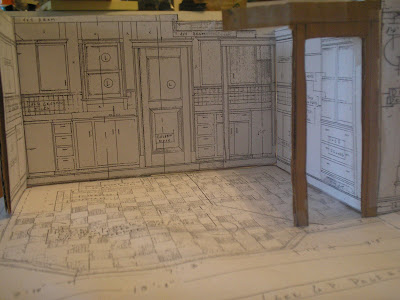
The designer, James Noone, removed the wall separating the living room from the kitchen...

The finished set!
I have met with Penny a few times this summer to discuss the my progress and the production, but each time I walk away wondering why I can’t move forward. During our last visit, Penny suggested I create a model to help me visualize the set and the arch of the production. Over the past eight years since I started exploring the world of light, I have always been able to observe the development of a production from the first reading to each rehearsal and the final run. This kind of attention and deep involvement has resulted in a few successful designs and many wonderful experiences, yet it is not a method that I will be able to practice as I move into the professional world. The hope is that by creating a model I will be able to visualize the action of the play in relationship to the scenery. By seeing the space 3-dimensionally, I will be able to calculate the desired angle and direction of the light, as well as, developing a light and color scheme that will enhance the overall production.
Here are a few photos of the model I built from the scenic designers draft…

Living room, the "x" means you can see through that part of the wall...

The designer, James Noone, removed the wall separating the living room from the kitchen...

The finished set!
Monday, June 29, 2009
Curiosity
I am beginning to work on a show entitled... "Curiosity". It is the exploration of Pandora's Box through the world of puppetry...
Here are a few great puppetry websites that I am using as starting points for inspiration and research...
1. Puppeteers
2. Pagesperso-orange
3. Sagecraft
4. Unima-USA
It is a world almost entirely new to me, and yet one that I have been profoundly influenced by and deeply intrigued in understanding. Something about manipulating a small world is a bit scintillating to me! I will be working with a number of my lighting design colleagues at UMass, Amherst to develop a lighting design that will help aid in telling a story and creating a world for the production.
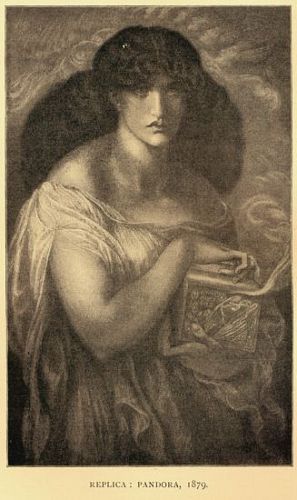
Here are a few of my starting points for research...

"A pithos from Crete, ca. 675 BC. Louvre"

"An Attic pyxis, 440–430 BC. British Museum"

"Pithoi at Knossos."

Dante Gabriel Rossetti, Replica: Pandora, 1879

Dante Gabriel Rossetti - Pandora
When you start a new project, where do you begin?
Here are a few great puppetry websites that I am using as starting points for inspiration and research...
1. Puppeteers
2. Pagesperso-orange
3. Sagecraft
4. Unima-USA
It is a world almost entirely new to me, and yet one that I have been profoundly influenced by and deeply intrigued in understanding. Something about manipulating a small world is a bit scintillating to me! I will be working with a number of my lighting design colleagues at UMass, Amherst to develop a lighting design that will help aid in telling a story and creating a world for the production.
Here are a few of my starting points for research...

"A pithos from Crete, ca. 675 BC. Louvre"

"An Attic pyxis, 440–430 BC. British Museum"

"Pithoi at Knossos."
Dante Gabriel Rossetti, Replica: Pandora, 1879
Dante Gabriel Rossetti - Pandora
When you start a new project, where do you begin?
Thursday, June 11, 2009
Lighting Design
So here's my question...
How do you design lights for a show, unless you know the show inside and out?
How do you design lights for a show, unless you know the physical action of the play inside and out?
How do you design lights for a show and call it art, unless you participate first hand in the creation of the art?
I say, "You can design lights for any show, whether you know it or not...you can design lights for any show, whether you know the physical action of the play inside out or not...you cannot design lights for a show and call it art however, if you don't participate first hand in the creation of the art..."
So, go...participate...communicate...collaborate...and enjoy!!!
How do you design lights for a show, unless you know the show inside and out?
How do you design lights for a show, unless you know the physical action of the play inside and out?
How do you design lights for a show and call it art, unless you participate first hand in the creation of the art?
I say, "You can design lights for any show, whether you know it or not...you can design lights for any show, whether you know the physical action of the play inside out or not...you cannot design lights for a show and call it art however, if you don't participate first hand in the creation of the art..."
So, go...participate...communicate...collaborate...and enjoy!!!
Subscribe to:
Posts (Atom)

