I am beginning to take notes and ask questions for our production of Marta the Divine at UMass, Amherst.
How do you decide when you have a character who could be cast as either a man or a woman? Keep in mind that the choice will change the tone and relationships in the play considerably. Do you choose based on the statement(s) that you want to make, or do you leave it to be decided by the turnout at auditions?
The opening of the play begins with a sonnet of mourning by the leading lady, and then another by her sister. Their brother has just been murdered by a man who happens to be both of the woman's lovers. I wonder how to approach the audience entrance into the theater and the opening of the play. The play as a whole is a comedy, yet this opening is very mournful and somber. Do I assist the playwright's deceptive opening and create a mournful atmosphere with the sound? Will the lighting and costume designers open the play with lighting that helps to create a somber mood/atmosphere and costumes that are worn during a time of mourning? Here are a few sound bites that inspire me for the audience entrance into the space and the first two sonnets by Marta and Lucía...
Great Thaw
Nostalgia B
(Argentina) Tango
Showing posts with label Costumes. Show all posts
Showing posts with label Costumes. Show all posts
Monday, July 13, 2009

Thursday, March 12, 2009
Theatrical Development

Marcus Gardley
I sat in on a production meeting today for ...And Jesus Moonwalks on the Mississippi by Marcus Gardley, our faculty playwright. I had been hearing a lot of conversation about the process...lots of information, lots of technology, frustration, challenges, questions, confusions...the real problem however isn't anybody or anything that has happened, but simply the fact that nearly nobody is used to working with so many unknowns. They aren't used to experimenting with the an ever evolving set, script, and production elements. I would love to work on this project, but my faculty adviser, Penny Remsen, decided that this was too close to my cup of tea. I have worked in experimental theatre for the past 9 years at both Westmont College and Lit Moon Theatre and I need to learn some other ways of approaching the art form.
Anyway, the experimental process is really having its toll on everybody! Here's the scenario...
The set keeps changing or being adjusted (in the grande scheme of things very minor adjustments, but adjustments nonetheless), the script is still being worked as the director, performers and playwright become more familiar with the characters in relationship to the actors, we are beginning to work with projections, lighting, and sound, and the production opens April 30th (7 weeks). Plenty of time if we weren't working with so many projections with equipment that is less than unsatisfactory for the purpose, as well as, so many students, faculty, and staff who are used to having a fixed set, ideas, and purposes.
So, here's the question...At what point do you stop changing the theatrical elements and start polishing them?
My personal thought...it never stops changing until the show closes for good...experiment until you can't experiment anymore!!!
Tuesday, March 10, 2009
History of Design
I am taking a class at UMass, Amherst entitled the History of Design taught by Miguel Romero...Before starting the class, I couldn't help but fear that I would be plunged back into an undergraduate environment studying facts, dates, and names...
I was quickly jolted into an array of my fears and dreams mixed together, shoved into my mouth, where I quickly chewed them up and vomited them back out in hopes that I would have another chance to see what I had been force fed. Luckily, I didn't have to re-eat the material I had previously spewed out, instead I was offered another host of information equally jolting, bitter, and exquisite. This time, however, I am able to pick and choose what I swallow, what I vomit out, and what I save for later.
Finding what images, facts, and fables are most intriguing will ultimately allow me to engage the material in a way that both stimulates my intellect and my creativity while re-enforcing the importance of experiencing visually and physically as much stimuli as is beyond physically possible in any given 75 minutes.
Here are just a few of those things that I found appetizing today...
Bramante

St. Peters Ground Plan...
I specifically like the ground plan for its symmetry, cross-like nature, and depth (I feel like I could place a magnifying glass on this image and continue on infinitely to another layer of crosses, squares, and circles). What a treat!!!

Encyclopedia Britannica's Tempietto, San Pietro in Montorio, Rome
This image represents a wonderfully theatrical lighting challenge...how do you illuminate the most important element of the structure, what is that element, or does that depend on the beholder and if so, then from which direction is the beholder beholding the structure???
Grunewald

Isenheim Crucifixion
My God look at that body! His body, limbs, fingers, toes, knees, sinews, bones and flesh are twisted, stretched, pierced, and broken!!! This image creates such a vibrant and powerful reflection upon the excruciating pain that was inflicted upon victims of crucifixion. Never before in my life have I seen an image of Christ so utterly broken, emaciated, and dead, yet so full of life. Please take a moment and cherish this artists work. View more of his pieces and stand in awe at the beauty of mannerism in his scenes and characters! (each emphasizes and epitomizes humanity)
Breughel

Spreekwoorden (De Blauwe Huik) Proverbs (aka Blue Cloak), 1559
Please, take a minute or two or ten to look closely at the image above. Click on it too and it will take you to a much larger version where you may break down the myriad of scenes represented in this work of art. What it might have been like to take this conglomeration of episodes, events, and scenarios and render them into such lifelike and emotional characters. What is more...what it would be like to take just a handful of these and recreate them for the live theatre. All happening at the same time, within, upon, and beneath each other. What a feast this man has given us to observe!!!
Here is more...I can't possibly breakdown a single work from all of these artists in one night let alone in one week..."breakdown"...I hardly did that...more like mention uncerimoniously my own brief thoughts on the images.
Tintoretto
Parmigianino
Bronzino
Bosch
Durer
Altdorfer
Fiorentino
Clouet
Cellini
Goujon
da Bologna
Titian
Veronese
Sofonisba Anguisola
Artemisia Gentilleschi
I was quickly jolted into an array of my fears and dreams mixed together, shoved into my mouth, where I quickly chewed them up and vomited them back out in hopes that I would have another chance to see what I had been force fed. Luckily, I didn't have to re-eat the material I had previously spewed out, instead I was offered another host of information equally jolting, bitter, and exquisite. This time, however, I am able to pick and choose what I swallow, what I vomit out, and what I save for later.
Finding what images, facts, and fables are most intriguing will ultimately allow me to engage the material in a way that both stimulates my intellect and my creativity while re-enforcing the importance of experiencing visually and physically as much stimuli as is beyond physically possible in any given 75 minutes.
Here are just a few of those things that I found appetizing today...
Bramante
St. Peters Ground Plan...
I specifically like the ground plan for its symmetry, cross-like nature, and depth (I feel like I could place a magnifying glass on this image and continue on infinitely to another layer of crosses, squares, and circles). What a treat!!!
Encyclopedia Britannica's Tempietto, San Pietro in Montorio, Rome
This image represents a wonderfully theatrical lighting challenge...how do you illuminate the most important element of the structure, what is that element, or does that depend on the beholder and if so, then from which direction is the beholder beholding the structure???
Grunewald
Isenheim Crucifixion
My God look at that body! His body, limbs, fingers, toes, knees, sinews, bones and flesh are twisted, stretched, pierced, and broken!!! This image creates such a vibrant and powerful reflection upon the excruciating pain that was inflicted upon victims of crucifixion. Never before in my life have I seen an image of Christ so utterly broken, emaciated, and dead, yet so full of life. Please take a moment and cherish this artists work. View more of his pieces and stand in awe at the beauty of mannerism in his scenes and characters! (each emphasizes and epitomizes humanity)
Breughel

Spreekwoorden (De Blauwe Huik) Proverbs (aka Blue Cloak), 1559
Please, take a minute or two or ten to look closely at the image above. Click on it too and it will take you to a much larger version where you may break down the myriad of scenes represented in this work of art. What it might have been like to take this conglomeration of episodes, events, and scenarios and render them into such lifelike and emotional characters. What is more...what it would be like to take just a handful of these and recreate them for the live theatre. All happening at the same time, within, upon, and beneath each other. What a feast this man has given us to observe!!!
Here is more...I can't possibly breakdown a single work from all of these artists in one night let alone in one week..."breakdown"...I hardly did that...more like mention uncerimoniously my own brief thoughts on the images.
Tintoretto
Parmigianino
Bronzino
Bosch
Durer
Altdorfer
Fiorentino
Clouet
Cellini
Goujon
da Bologna
Titian
Veronese
Sofonisba Anguisola
Artemisia Gentilleschi
Friday, March 6, 2009
Devised Theatre
Well, we have come up with a full script. A 30 minute long journey through the birth, growth, and death of a relationship with a twist. We have been playing with multi-stable illusions...
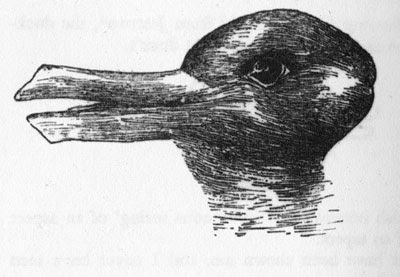
What do you see...?
This idea of seeing action and dialogue from different perspectives, stories, and/or people. I love what we have created, and I can't wait to start putting the scenic elements together with the movement and language. It is going to be a feast for lighting and sound to play with!
Here is a little taste of a movement section:
...and door-handle, with a marker. The marker drops; the child skips off.
(2)
The door, which was exacto-knifed onto the box before the start of the production, opens, and out walks a homeless man. He picks up the marker
Here is a little taste of a section of dialogue:
PSYCHIC
(looking in crystal ball)
I see…
MAN
(worried)
Is it bad?
PSYCHIC
(seeing his worry, fishing)
It’s not good, no. You’re not married?
Change the circumstance...
MAN
I see.
LOVER
Is it bad?
MAN
It’s not.
LOVER
Good. (Crosses to him)
MAN
No.
LOVER
You’re not married.
At any rate...I can't wait to keep working on the production...I am curious how many of you are working on a piece of devised theatre? or When was the last time you worked on a piece of devised theatre...?
Wednesday, March 4, 2009
When We Dead Wake
I have been working on a play by Henrik Ibsen, one of my favorite playwrights. When We Dead Wake was the last play he wrote, although he did not intend for it to be his last play :(
Here are a few thoughts I have had as I prepare for my presentation on Friday...
Imagine a man and a woman...husband and wife who become pregnant with their first child. They go through all the joys of pregnancy and the gestational period, yet after nearly 20 hours of labor the result is not a beautiful, warm, crying child, but a deformed, cold, lifeless and silent child. The realization that the pregnancy resulted in nothing more than death and memories causes a slow, painful, and twisted awakening for those involved, dragged in, and looking on...
Now, imagine the audience walks in to this pure white, crisp, clean set with Maja and Rubek set in a tableau... By the time the audience is settleed Maja and Rubek have changed slowly into various tableaus. As their dialogue reaches their first mention of death we have slowly brought in a mild hint of a dull cool blue on the set behind them out of their direct view.
Please visit again as I continue to develop these ideas...I hope to have the rest of my presentation complete before it is due this Friday. Any thoughts???
(For images of my inspiration for living sculptures you may go to Project 4 work by Jenna McCracken; for images of my inspiration for the set you may go to Project 4 work by Alex Gutierrez; for images of my inspiration for the tone and feeling of each act, as well as, some basic color pallettes you may go to Charles Cramer's site and observe specifically his Yosemite images; and to listen to the music I have chosen to inspire me you may listen to "I Touch Myself" by Divinyls.)
Tuesday, February 24, 2009
Pericles iv.
We are moving in to our first dress rehearsal tonight! I am very excited to run the show with as few stops as possible. Our Lighting designer, Thad Kramer, a 1st year graduate student at UMASS (and a fantastic designer), has been developing his ideas for several months and building cues for several days, and he finally get's to see the fruits of his labors. Although he will be making adjustments to the cues while I take notes for him, he is pretty much finished and ready to go. It is has been a wonderful experience working with Director, Shawn LaCount, a third year grad in our program at UMASS, and Artistic Director of Company One in Boston, MA. His constant communication, interaction and support during the development of the production and specifically during the technical runs, has been absolutely integral to the success of this production. I cannot say how important it is for a lighting designer to have constant interaction with the designers and especially the director. A steady flow of communication ensures that the cues being built by the lighting designer are those that have been dreamed of and blocked by the design team and performers.
So, thank you to you all for such a great experience, and I hope these next few days result in a production that excites audiences, gives joy to the cast and crew, and does justice to the artistic process!!!
Congrats to all!
So, thank you to you all for such a great experience, and I hope these next few days result in a production that excites audiences, gives joy to the cast and crew, and does justice to the artistic process!!!
Congrats to all!
Sunday, February 22, 2009
Pericles iii.
Wow! What an amazing process!! I love working on productions that require lots of communication (funny right...what show doesn't require lots of communication)...perhaps, what I ought to say is...I love working on productions where we actually do a lot of communicating! I think this production of Pericles will be a fabulous and exciting production. Lot's of promising moments and scenes. We will be adding costumes to the tech process tonight. This will add the final missing and exciting element to the production. The costumes are amazing. Heather (our third year grad student) has developed an incredible array of costumes. Somewhere near 50 costumes for 18 different actors. What a feat...and our costume shop is working hard to make this a reality. Thank you guys! Your work is deeply appreciated!!! Hurray!!! for the cast and crew of Pericles... :)
Wednesday, November 26, 2008
Imaginary Invalid vii.

Dora Arreola (Graduate Candidate for Directing MFA) staging the prologue...
Day four is now complete...We had a fantastic run through of act 1. I have a number of cues to adjust. I think they need some attention to focus on the stage, dark spots for actors moving through the space, and highlights on the set, a lot of attention to the upstage drop and the drops outside the windows, but other than that I have a nice shape to Act 1.
I will be developing the final cues for Act 2 and into the Prologue during a cue over this up-coming Monday. I will be able to make minor adjustments to the general lighting cues that I have created. I hope to get a clear sense of the direction I am going in for the Epilogue after this rehearsal.
Then moving into Tuesday next week, we will be wrapping up the final tech of the Epilogue, and then it is a matter of finessing the blocking to the lighting and the lighting to the blocking, in order to ensure that the actors are always visible, especially the eyes.
Tuesday, November 25, 2008
Imaginary Invalid vi.

2nd cue in Act I...(not a very good camera...sorry)...
Day three has been tacked up on the complete board for the Invalid tech. My advisor, Penny Remsen, met with me at couple of different time yesterday to discuss the process, the systems of lighting that she has taught me how to create, and the process of layering them in through the production. I am used to creating cues virtually seperate from each other...each cue almost being its own entity seperate from the cue before. The only thing that is usually the same is the instruments I am using. So, the same brushes, just different paint, to use an artist example of how to paint a set with light.
Here are just a few things that I learned from this process...
1. Never stress
2. Don't apologize
3. Start with the first cue and layer in the light progressively from cue to cue. (This is an indoor set (living room), period play (Moliere), essentially afternoon to twilight, and one room). So, I don't have a lot of need for drastically different lighting. I can create essentially two pallettes (afternoon and evening) and have exactly what I need to cue the show. Good thing for me, that is exactly what I did on paper, and now it is working on the actual set.
4. Do not draw the audience attention away from the actors unless the actors are directing the audience attention to a specific object or location in the set.
5. Color is very important and does not always work the same on paper as it does on the real set...always be ready with back-up gels and ideas, in case color choices need to be adjusted. It may be the right color, but the wrong saturation.
6. Technical rehearsals never work the same from show to show, director to director, and crew to crew. I am learning so many things with this process. Yesterday, I was on information overload, and especially the day before. I am now beginning to process all the information. I hope I can retain all of or most of it for the next round of designs.
Monday, November 24, 2008
Imaginary Invalid v.

Actor warm-up...
We finished day two of tech last night, however, I walked away from that day frustrated with myself for not understanding how the light is working on the set. I am beginning to see it more, but the paper choices I made are not all working. It may be a matter of color, but I am not sure if it is...? I also came away from yesterday disappointed in the design team as a whole. We did not communicate to each other as well as I have been hoping we would or could. As Rob said yesterday, "We are trying to blend design ideas together rather than finding a single direction to work as a whole." I agree that we have done this, but I am not sure at this point if that can be corrected. We never had any design meetings longer than 1 hour, and we never met as a whole group after the pre-liminary scenic and costume design were made. We never had any design or production notes taken or plans about what we were going to address in these meetings. It has always been a kind of check in and never a growing of ideas and exploring.
I have never worked through a tech where I received so little information from other designers and especially from the director. I assumed that what was being seen was understood as the cue for the show, but apparently all the cues that I have written except for the prologue and into Act I scene 1 are not being conisdered as the final cue. I don't know when we are going to write the final cue if it was not this weekend. I know we have two more tech/design runs tonight, but they are essentially runs and not stop and go as we definitely need. Anyway, I should have been talking more with Dora, and asked her to come sit behind me so that we could collaborate...checked in with her that what we had written was good (as well as if it was good with the other designers)...and then moved on to the next cue. I wonder what the next step is...do we step through now and get the approval...do we step through and assume that the cues are good unless someone stops me. (That is what I was doing the last two days, but apparently that is not a good method)...any suggestions...???
Sunday, November 23, 2008
Imaginary Invalid iv.

Starting the day...Thad editing a cue list...
Yesterday we started our official tech day. What a long and enriching and exhausting experience! I have worked long days, but rarely ones that require so much focus on what light is doing in so many different places, yet really only within a small frame. Comparatively the world we live in has so many different aspects of lighting, but mostly out of our control. This however, in the theatre, I have complete control, yet the control in this particular production is coming from a much larger number of sources than I am used to working with. Harnessing all that light into a cohesive whole has been challenging. I need to remember to start with my key light, then filter in my fill light. One last challenging thing with this process is the difference between my definition of comic and others definition of comic...or rather our definition of how lighting enhances or detracts from the comedy of a show. How does your light in your world make your life more comic or more tragic?
Thursday, October 2, 2008
Scenic elements for the sake of art or spectacle
Well, we have come across another great question! Are we making choices in our art that are developed out of the art form, out of the subject, out of the text, OR are they a result of a desired effect, an audience response, because it looks cool...Here are some questions we are asking about light boxes in our set...are they justified...are they a part of the world of the main character or are they here for a neat effect?
I have been putting a lot of thought into these light boxes over the past few hours, and I have some great questions that have developed from working with our mock up light box, talking with Rob, and talking with Thad. I hope you will take these questions and embrace them with more questions, answers, or thoughts.
To get the technical question out of the way...How much of the cost for the light boxes is coming out of the scenic budget, and how much is coming out of the lighting budget? I think this is a great question, because I would assume that it is coming out of both, but I do not have any idea as to how much it would cost to light the various surfaces that we are planning to light. How much would it cost for gel, lamp fixtures, fire proofing, etc...?
Also, is the light box that we set-up today even close to what we might be actually using? What we used today revealed some great images, but I doubt it was anything like what we will be using. We used a Parnel down the opening of the box where the light hit both the white background and the painted image, but will this be the same intensity if we use incandescent lights, are there OSHA regulations with lighting instruments that we have to abide by?
Now on to the more artistic and dramatic questions...
Are we forcing this effect onto the production because we liked it at one point, had a reason for it at one point, yet we have not discussed it at all since the beginning...so, is it really a developed part of the play, or is it merely an effect that we want to use?
If we can't communicate clearly to our faculty why we want to use these boxes, how we will use these boxes, and when we will use these boxes, then how are we going to convince an audience that these are integral to the production, and not merely a nice effect?
If we wait to the end of the play to reveal the light boxes during the fake death scenes, then we will detract from the actors performance, so that the audience is watching the boxes rather than the action. It will be such a powerful effect that the audience will not embrace both the acting and the scenic elements.
Personally, when I first imagined the light boxes being used in this space, I imagined them coming on at various points in the play, and never turning off. I never imagined them only coming on at the end of the play. I imagine them coming on whenever we have a breath of fresh air (when a window is opened, an entrance made, a door opened). I imagine the air in the house slowly becoming more and more breathable. We start stuffy, claustrophobic, and stale; then as the various characters enter and exit we begin to smell there different aromas, but as the play progresses the aromas of Angelique, Toinette, Cleante, and even Argan overwhelm and infuse the area with a freshness that no bad scent can extinguish. If we can embrace the light boxes as an element in the play, as part of the world of the play, then they may be justified, but if we are only using them for a moment, cued by a line, then they are merely spectacle and have no place in Argan's world.
There are more questions to be asked, more thoughts to be heard. I hope that we can embrace the use of the e-mail to help facilitate a conversation outside of meetings to help us develop how these light boxes are used, why they are used, and when they are used.
I love Theatre!!!!
Subscribe to:
Posts (Atom)

