Traci Klainer, my lighting design professor at the UMass, Amherst, invited me to observe the focus and tech for her lighting design of THE IRISH CURSE. The night before my journey down to NYC I went through a variety of lists to make sure I had everything I would need for stay. I woke up just before dawn the morning of our Spring time change and headed for the train station. On the ride down, I spent a peaceful 9o minutes updating a light plot for BARNUM: THE GREATEST SHOW ON EARTH. I think there is nothing better than spending some quiet time creating.
My journey quickly came to an end as we pulled into Grand Central Terminal. I found my way quickly to the Shuttle toward 42nd Street, and then made my way to the C train, which was an unexpected hike in the subway tunnels of NYC. Once I returned to the surface, fresh air, and some wonderful rainy sunlight, I began to make my way over to the SoHo Playhouse. Of course I walked a couple of blocks in the wrong direction :)
After a brief phone call to my wife, I ventured into the building where a busy crew was hard at work focusing, re-hanging as needed, and making the appropriate work notes for the afternoon session. This experience was particularly wonderful for me, because it allowed me the opportunity to see my professor execute two-thirds of her design. As she often tells us, 0ne-third of the design is the light plot, 0ne-third is the focus, and 0ne-third is the cuing. Watching Traci command the attention of the room as she rapidly bounced from one side of the stage to the next with her trusty magic sheet in hand was energizing and exciting. It was even better than the peaceful time I spent on the train designing my plot. Turning on lights can be so exciting, sometimes frustrating, and always illuminating :)
Once Traci hit her stride, she brought me up on stage to stand in the light as she made sure each light was accomplishing its prescribed goal. In a way, the focus is like preparing the canvas for the first attempt at creating the background for a wonderful work of art. This process was soon complete, and we all headed off in our different directions to find some much needed dinner and rest. As the sun quickly set and the night sky took over, I found myself drifting off to dreams of lights, sound, scenery, and performance. I love dreaming about work! (At least when those dreams are productive and inspiring.)
After waking up, having a wonderful conversation with my wife and children, I found my way back downtown. Upon arrival, I was quickly assigned the task of procuring a monitor for our ETC Impression light board, which had been used the day before without a monitor (since the original one was no longer working). A few blocks, a hand truck, and a couple of phone calls later we had a light board with monitor all ready to go for the first day of tech. Some last minute lighting adjustments were made, and a lunch break was in order.
Through the process of the afternoon, I was introduced to the playwright, director, sound designer, costume designer, and production staff. A wonderful group of men and women! I was particularly excited about my conversations with the playwright. We briefly spoke about a paper project I worked on with one of his plays, and the potential for working with another of his plays in the future. If this play he was speaking of is anything like SCITUATE and THE IRISH CURSE, then I am sure I am in for a wonderful and exciting ride. There are so many wonderful things about what I do for a living, and meeting exciting, creative people like Martin Casella is just one of the best!
After the day of focus, it was clear that Traci's design was simple, but not without its challenges. The theater is small, low ceilings, and most lights needed to be hung on uni-strut (not the easiest of materials to work with). Yet despite these challenges, Traci was able to shape the space with her lights in a way that created a smoothe wash of the space and drew attention to the center of the space where a majority of the action takes place. She accomplished this in such a way that one's attention would not be distracted by the host of lights hovering a mere 3 feet above the actors heads. Not a small feat to accomplish, I am quite impressed, even though I expected nothing less. Her greatest accomplishments with the simple design were the way she addressed the set so that the audience was able to become that sixth person on stage. The way Traci's light danced in the space not only invited the audience into the atmosphere created by Lauren Helpern's scenic design, but also into the world of the story being told.
Needless to say this was a very exciting couple of days for me, and I wish them nothing but joy and success with this lovely and hilarious production. If you have some free time and want to see a piece of theater, then THE IRISH CURSE would be a perfect way to spend an evening. Congratulations to the team and happy opening!!!
Showing posts with label Scenery. Show all posts
Showing posts with label Scenery. Show all posts
Tuesday, March 16, 2010

Friday, October 2, 2009
Developing the Design
Yesterday, our production team met during our weekly scheduled hour. I had been anticipating this meeting with great excitement and hopes for a wonderful conversation. I got more than I bargained for...!
Last week, I had made a decision to move away from my original design ideas. I had decided not to use fluorescent lights throughout the entire space, and to only use them for the audience lighting. I was concerned that I wouldn't be able to pass them as safe, that I wouldn't have as much control of them as I would like, and that they would not be capable of being smoothly integrated into the cuing process. As a result of this decision, I designed a lighting system that would support the idea of a fluorescent lit world. I am very happy that I did this, because now that I am moving back to the fluorescent lighting idea, I have both fluorescent lights and a system that will support them. I should mention that one of my advisers couldn't have met with me at a more perfect time. She was able to encourage me and drive me forward with my design and to put my fears aside, go with my instincts, and light the world of the play.
During the meeting, I was met with encouragement to place the fluorescent lights wherever I wanted to, and that we would find the ways necessary to make them safe. I was also met with very little frustration at the idea of using them, regardless of how much control I would have of them. In fact, people were more than willing to suggest ways to paint/dress them in a way that would integrate them into the world more, and to wait and see just how much control we could achieve with them as we begin to use them in the space.
Currently, I have planned for five 8 foot fluorescents and five 4 foot fluorescents to be used in the set. I have a total of fourteen 8 foot fluorescents and seven 4 foot fluorescents to use in total.

Here is an image of the set before we make any changes...
Last night, after our production meeting the scenic designer proposed a bold change to the set that would use the fluorescents to there max. He suggested that we get rid of the current set as it exists (about 8 beams or so spread out throughout the space) and build a fluorescent light installation. I am of course very excited about this idea. I am, however, a little concerned that if we get rid of the beams entirely that we will lose much of what makes these fluorescents work so well. They work in the design because of the scenic elements that I am installing the fluorescents to. I want to attach fluorescents to the existing architecture in the theater as well as the existing beams in the set as it exists. If we don't use the beams, then I think it would be to our benefit if we stick to shaping the existing architecture. The fluorescents work best as they are, if they are highlighting edges, shapes, and actors from unnatural angles and directions.
At any rate, I am very excited about getting into the space today, focusing the rep-plot for the Curtain Theater, and then beginning to install the fluorescents in places that I think they will be most effective. Then, on Saturday morning, Dennis (scenic designer) and I will continue to explore the most effective configurations of these fluorescent lights. I can't wait to see in the full scale model where he might be thinking of placing them.
Last week, I had made a decision to move away from my original design ideas. I had decided not to use fluorescent lights throughout the entire space, and to only use them for the audience lighting. I was concerned that I wouldn't be able to pass them as safe, that I wouldn't have as much control of them as I would like, and that they would not be capable of being smoothly integrated into the cuing process. As a result of this decision, I designed a lighting system that would support the idea of a fluorescent lit world. I am very happy that I did this, because now that I am moving back to the fluorescent lighting idea, I have both fluorescent lights and a system that will support them. I should mention that one of my advisers couldn't have met with me at a more perfect time. She was able to encourage me and drive me forward with my design and to put my fears aside, go with my instincts, and light the world of the play.
During the meeting, I was met with encouragement to place the fluorescent lights wherever I wanted to, and that we would find the ways necessary to make them safe. I was also met with very little frustration at the idea of using them, regardless of how much control I would have of them. In fact, people were more than willing to suggest ways to paint/dress them in a way that would integrate them into the world more, and to wait and see just how much control we could achieve with them as we begin to use them in the space.
Currently, I have planned for five 8 foot fluorescents and five 4 foot fluorescents to be used in the set. I have a total of fourteen 8 foot fluorescents and seven 4 foot fluorescents to use in total.

Here is an image of the set before we make any changes...
Last night, after our production meeting the scenic designer proposed a bold change to the set that would use the fluorescents to there max. He suggested that we get rid of the current set as it exists (about 8 beams or so spread out throughout the space) and build a fluorescent light installation. I am of course very excited about this idea. I am, however, a little concerned that if we get rid of the beams entirely that we will lose much of what makes these fluorescents work so well. They work in the design because of the scenic elements that I am installing the fluorescents to. I want to attach fluorescents to the existing architecture in the theater as well as the existing beams in the set as it exists. If we don't use the beams, then I think it would be to our benefit if we stick to shaping the existing architecture. The fluorescents work best as they are, if they are highlighting edges, shapes, and actors from unnatural angles and directions.
At any rate, I am very excited about getting into the space today, focusing the rep-plot for the Curtain Theater, and then beginning to install the fluorescents in places that I think they will be most effective. Then, on Saturday morning, Dennis (scenic designer) and I will continue to explore the most effective configurations of these fluorescent lights. I can't wait to see in the full scale model where he might be thinking of placing them.
Wednesday, July 15, 2009
Abandoned Theater
After reading the brief prologue for our production of Frank Wedekind's, Spring Awakening, I decided I needed to take a step into the water before deciding it was unpleasant. Here is the prologue our Director, Toby Bercovici and our Dramaturg, Emily Denison have created after many long hours of adapting the play:
Prologue. "It is nighttime, an abandoned theatre or theatrical warehouse or playground. Out of the darkness come tumbling sprites - they are children, in nightgowns and pajamas, pigtailed, innocent and playful. But there is something ghoulish about them, as well. They stand on each other’s shoulders and do other acrobatics, maybe some lazzi (hitting each other with sticks), they discover the masks and try them on, they “play dress up.” Out of this emerges Beat One."
I was skeptical about the first sentence and loved the rest. Now, I think I have fallen in love with the first sentence, and I am happy to say, I have no fear of ever returning back to my skeptical first impression. Needless to say, "First impressions are bad."
So, here are some images and websites I researched on the trusty Google Image search engine, key words: "industrial playground" and "abandoned theater" and "theater warehouse."
Industrial Playground:
tickled: I love this image! It is so fun and playful, while a tad creepy!!
two fathoms: A beautiful image of an open industrial place to play.
forces within: I don't know how to create this, but it might be interesting for our Desdemona moment!

This looks like so much fun!

Industrial Playground
Abandoned Theater:

Abandoned Theater

Notice the trash on the stage! It is actually clothing!...

Thank you WebUrbanist for these beautiful images!
Theater Warehouse:

My first instinct when I think of a theatrical warehouse...

My second instinct...

Now we're talking a lil' more interesting...

Now we're talkin' interesting! Buntport
I hope you have enjoyed a little journey into some of my visual research. Come back for a little more as I continue to break the play down to find my way in and out!
Prologue. "It is nighttime, an abandoned theatre or theatrical warehouse or playground. Out of the darkness come tumbling sprites - they are children, in nightgowns and pajamas, pigtailed, innocent and playful. But there is something ghoulish about them, as well. They stand on each other’s shoulders and do other acrobatics, maybe some lazzi (hitting each other with sticks), they discover the masks and try them on, they “play dress up.” Out of this emerges Beat One."
I was skeptical about the first sentence and loved the rest. Now, I think I have fallen in love with the first sentence, and I am happy to say, I have no fear of ever returning back to my skeptical first impression. Needless to say, "First impressions are bad."
So, here are some images and websites I researched on the trusty Google Image search engine, key words: "industrial playground" and "abandoned theater" and "theater warehouse."
Industrial Playground:
tickled: I love this image! It is so fun and playful, while a tad creepy!!
two fathoms: A beautiful image of an open industrial place to play.
forces within: I don't know how to create this, but it might be interesting for our Desdemona moment!
This looks like so much fun!
Industrial Playground
Abandoned Theater:
Abandoned Theater
Notice the trash on the stage! It is actually clothing!...
Thank you WebUrbanist for these beautiful images!
Theater Warehouse:
My first instinct when I think of a theatrical warehouse...
My second instinct...
Now we're talking a lil' more interesting...
Now we're talkin' interesting! Buntport
I hope you have enjoyed a little journey into some of my visual research. Come back for a little more as I continue to break the play down to find my way in and out!
Friday, July 10, 2009
Burial At Thebes
I have been working on an adaptation of Sophocles' Antigone by Seamus Heaney entitled Burial At Thebes. It is a fantastic adaptation with only a few minor quibbles (a few words out of place compared to the rest of the text like "boss" or "shit"). I have perused the text a couple of times, once for enjoyment and the other for questions and concerns. The reading produced a wonderful interaction between the director and myself, and one, I hope, that will continue throughout the rest of the process. I can't emphasize how important it is for me to have a strong interactive experience with my fellow artists. It really must be a collaborative design for me to enjoy the process.
Yesterday, I met on Skype with our scenic designer. We used a program called Innerpass, where I was able to see his screen from my computer. Perfect for what we are doing since it gave me the opportunity to see his renderings of what he hopes the set will look like. We tried to save an image file of it on my computer but failed; otherwise, I would show you a shot of his work. I am really excited about the use of corrugated steal for creating a texture on the walls and a concrete treatment for the beams. He had an idea to purchase some kind of gravel, stone, or rubble for our stage floor, rather than using a paint treatment. I think it is a wonderful idea that will make the scenic elements more visceral and tangible. Finally, he showed me an aspect of our risers, which allows me to light between the levels and possibly produce some mist, haze, or steam coming out of them. I can't wait to put this thing together...
Here are some images of the research I have been doing for the production in terms of lighting design...

Energy bank...

Illuminate...

Fantastic structures lurk behind our walls...

Construction/Industrial lighting design...

Simple yet beautiful...
Yesterday, I met on Skype with our scenic designer. We used a program called Innerpass, where I was able to see his screen from my computer. Perfect for what we are doing since it gave me the opportunity to see his renderings of what he hopes the set will look like. We tried to save an image file of it on my computer but failed; otherwise, I would show you a shot of his work. I am really excited about the use of corrugated steal for creating a texture on the walls and a concrete treatment for the beams. He had an idea to purchase some kind of gravel, stone, or rubble for our stage floor, rather than using a paint treatment. I think it is a wonderful idea that will make the scenic elements more visceral and tangible. Finally, he showed me an aspect of our risers, which allows me to light between the levels and possibly produce some mist, haze, or steam coming out of them. I can't wait to put this thing together...
Here are some images of the research I have been doing for the production in terms of lighting design...

Energy bank...

Illuminate...

Fantastic structures lurk behind our walls...

Construction/Industrial lighting design...

Simple yet beautiful...
Wednesday, July 8, 2009
Visualizing the Design
As many of you know, I am studying at the University of Massachusetts, Amherst for my MFA in Lighting Design. At the beginning of the 2009 Spring semester, I was assigned a paper project on William Inge’s Come Back, Little Sheba. It was to be my last assignment for the semester, and although I had all the materials to begin my research for the production, I chose to wait until I had cleared my plate. However, what I forgot at the time was that this semester was to be a seven-course meal, and the largest course, Come Back, Little Sheba, was to be the last course. So, before I had cleared each plate, another larger plate would be served. Needless to say, I wasn’t prepared for my first seven-course meal. I was able to get to the seventh course, but once I got there I couldn’t finish it. Luckily, my advisor, Penny Remsen, gave me a doggy bag to take home with me, but she is coming back in August to make sure I have taken in and digested the production.
I have met with Penny a few times this summer to discuss the my progress and the production, but each time I walk away wondering why I can’t move forward. During our last visit, Penny suggested I create a model to help me visualize the set and the arch of the production. Over the past eight years since I started exploring the world of light, I have always been able to observe the development of a production from the first reading to each rehearsal and the final run. This kind of attention and deep involvement has resulted in a few successful designs and many wonderful experiences, yet it is not a method that I will be able to practice as I move into the professional world. The hope is that by creating a model I will be able to visualize the action of the play in relationship to the scenery. By seeing the space 3-dimensionally, I will be able to calculate the desired angle and direction of the light, as well as, developing a light and color scheme that will enhance the overall production.
Here are a few photos of the model I built from the scenic designers draft…

Living room, the "x" means you can see through that part of the wall...
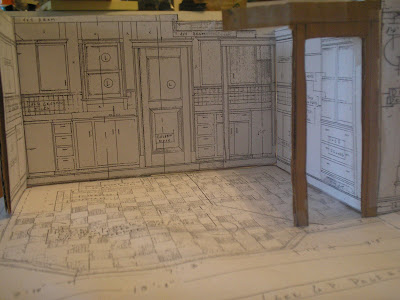
The designer, James Noone, removed the wall separating the living room from the kitchen...

The finished set!
I have met with Penny a few times this summer to discuss the my progress and the production, but each time I walk away wondering why I can’t move forward. During our last visit, Penny suggested I create a model to help me visualize the set and the arch of the production. Over the past eight years since I started exploring the world of light, I have always been able to observe the development of a production from the first reading to each rehearsal and the final run. This kind of attention and deep involvement has resulted in a few successful designs and many wonderful experiences, yet it is not a method that I will be able to practice as I move into the professional world. The hope is that by creating a model I will be able to visualize the action of the play in relationship to the scenery. By seeing the space 3-dimensionally, I will be able to calculate the desired angle and direction of the light, as well as, developing a light and color scheme that will enhance the overall production.
Here are a few photos of the model I built from the scenic designers draft…

Living room, the "x" means you can see through that part of the wall...

The designer, James Noone, removed the wall separating the living room from the kitchen...

The finished set!
Thursday, March 12, 2009
Theatrical Development

Marcus Gardley
I sat in on a production meeting today for ...And Jesus Moonwalks on the Mississippi by Marcus Gardley, our faculty playwright. I had been hearing a lot of conversation about the process...lots of information, lots of technology, frustration, challenges, questions, confusions...the real problem however isn't anybody or anything that has happened, but simply the fact that nearly nobody is used to working with so many unknowns. They aren't used to experimenting with the an ever evolving set, script, and production elements. I would love to work on this project, but my faculty adviser, Penny Remsen, decided that this was too close to my cup of tea. I have worked in experimental theatre for the past 9 years at both Westmont College and Lit Moon Theatre and I need to learn some other ways of approaching the art form.
Anyway, the experimental process is really having its toll on everybody! Here's the scenario...
The set keeps changing or being adjusted (in the grande scheme of things very minor adjustments, but adjustments nonetheless), the script is still being worked as the director, performers and playwright become more familiar with the characters in relationship to the actors, we are beginning to work with projections, lighting, and sound, and the production opens April 30th (7 weeks). Plenty of time if we weren't working with so many projections with equipment that is less than unsatisfactory for the purpose, as well as, so many students, faculty, and staff who are used to having a fixed set, ideas, and purposes.
So, here's the question...At what point do you stop changing the theatrical elements and start polishing them?
My personal thought...it never stops changing until the show closes for good...experiment until you can't experiment anymore!!!
Tuesday, March 10, 2009
History of Design
I am taking a class at UMass, Amherst entitled the History of Design taught by Miguel Romero...Before starting the class, I couldn't help but fear that I would be plunged back into an undergraduate environment studying facts, dates, and names...
I was quickly jolted into an array of my fears and dreams mixed together, shoved into my mouth, where I quickly chewed them up and vomited them back out in hopes that I would have another chance to see what I had been force fed. Luckily, I didn't have to re-eat the material I had previously spewed out, instead I was offered another host of information equally jolting, bitter, and exquisite. This time, however, I am able to pick and choose what I swallow, what I vomit out, and what I save for later.
Finding what images, facts, and fables are most intriguing will ultimately allow me to engage the material in a way that both stimulates my intellect and my creativity while re-enforcing the importance of experiencing visually and physically as much stimuli as is beyond physically possible in any given 75 minutes.
Here are just a few of those things that I found appetizing today...
Bramante

St. Peters Ground Plan...
I specifically like the ground plan for its symmetry, cross-like nature, and depth (I feel like I could place a magnifying glass on this image and continue on infinitely to another layer of crosses, squares, and circles). What a treat!!!

Encyclopedia Britannica's Tempietto, San Pietro in Montorio, Rome
This image represents a wonderfully theatrical lighting challenge...how do you illuminate the most important element of the structure, what is that element, or does that depend on the beholder and if so, then from which direction is the beholder beholding the structure???
Grunewald

Isenheim Crucifixion
My God look at that body! His body, limbs, fingers, toes, knees, sinews, bones and flesh are twisted, stretched, pierced, and broken!!! This image creates such a vibrant and powerful reflection upon the excruciating pain that was inflicted upon victims of crucifixion. Never before in my life have I seen an image of Christ so utterly broken, emaciated, and dead, yet so full of life. Please take a moment and cherish this artists work. View more of his pieces and stand in awe at the beauty of mannerism in his scenes and characters! (each emphasizes and epitomizes humanity)
Breughel

Spreekwoorden (De Blauwe Huik) Proverbs (aka Blue Cloak), 1559
Please, take a minute or two or ten to look closely at the image above. Click on it too and it will take you to a much larger version where you may break down the myriad of scenes represented in this work of art. What it might have been like to take this conglomeration of episodes, events, and scenarios and render them into such lifelike and emotional characters. What is more...what it would be like to take just a handful of these and recreate them for the live theatre. All happening at the same time, within, upon, and beneath each other. What a feast this man has given us to observe!!!
Here is more...I can't possibly breakdown a single work from all of these artists in one night let alone in one week..."breakdown"...I hardly did that...more like mention uncerimoniously my own brief thoughts on the images.
Tintoretto
Parmigianino
Bronzino
Bosch
Durer
Altdorfer
Fiorentino
Clouet
Cellini
Goujon
da Bologna
Titian
Veronese
Sofonisba Anguisola
Artemisia Gentilleschi
I was quickly jolted into an array of my fears and dreams mixed together, shoved into my mouth, where I quickly chewed them up and vomited them back out in hopes that I would have another chance to see what I had been force fed. Luckily, I didn't have to re-eat the material I had previously spewed out, instead I was offered another host of information equally jolting, bitter, and exquisite. This time, however, I am able to pick and choose what I swallow, what I vomit out, and what I save for later.
Finding what images, facts, and fables are most intriguing will ultimately allow me to engage the material in a way that both stimulates my intellect and my creativity while re-enforcing the importance of experiencing visually and physically as much stimuli as is beyond physically possible in any given 75 minutes.
Here are just a few of those things that I found appetizing today...
Bramante
St. Peters Ground Plan...
I specifically like the ground plan for its symmetry, cross-like nature, and depth (I feel like I could place a magnifying glass on this image and continue on infinitely to another layer of crosses, squares, and circles). What a treat!!!
Encyclopedia Britannica's Tempietto, San Pietro in Montorio, Rome
This image represents a wonderfully theatrical lighting challenge...how do you illuminate the most important element of the structure, what is that element, or does that depend on the beholder and if so, then from which direction is the beholder beholding the structure???
Grunewald
Isenheim Crucifixion
My God look at that body! His body, limbs, fingers, toes, knees, sinews, bones and flesh are twisted, stretched, pierced, and broken!!! This image creates such a vibrant and powerful reflection upon the excruciating pain that was inflicted upon victims of crucifixion. Never before in my life have I seen an image of Christ so utterly broken, emaciated, and dead, yet so full of life. Please take a moment and cherish this artists work. View more of his pieces and stand in awe at the beauty of mannerism in his scenes and characters! (each emphasizes and epitomizes humanity)
Breughel

Spreekwoorden (De Blauwe Huik) Proverbs (aka Blue Cloak), 1559
Please, take a minute or two or ten to look closely at the image above. Click on it too and it will take you to a much larger version where you may break down the myriad of scenes represented in this work of art. What it might have been like to take this conglomeration of episodes, events, and scenarios and render them into such lifelike and emotional characters. What is more...what it would be like to take just a handful of these and recreate them for the live theatre. All happening at the same time, within, upon, and beneath each other. What a feast this man has given us to observe!!!
Here is more...I can't possibly breakdown a single work from all of these artists in one night let alone in one week..."breakdown"...I hardly did that...more like mention uncerimoniously my own brief thoughts on the images.
Tintoretto
Parmigianino
Bronzino
Bosch
Durer
Altdorfer
Fiorentino
Clouet
Cellini
Goujon
da Bologna
Titian
Veronese
Sofonisba Anguisola
Artemisia Gentilleschi
Friday, March 6, 2009
Devised Theatre
Well, we have come up with a full script. A 30 minute long journey through the birth, growth, and death of a relationship with a twist. We have been playing with multi-stable illusions...
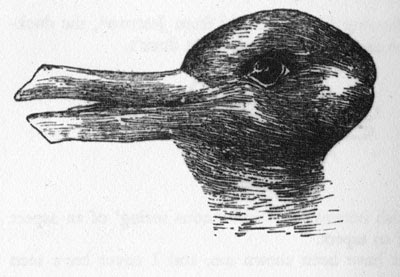
What do you see...?
This idea of seeing action and dialogue from different perspectives, stories, and/or people. I love what we have created, and I can't wait to start putting the scenic elements together with the movement and language. It is going to be a feast for lighting and sound to play with!
Here is a little taste of a movement section:
...and door-handle, with a marker. The marker drops; the child skips off.
(2)
The door, which was exacto-knifed onto the box before the start of the production, opens, and out walks a homeless man. He picks up the marker
Here is a little taste of a section of dialogue:
PSYCHIC
(looking in crystal ball)
I see…
MAN
(worried)
Is it bad?
PSYCHIC
(seeing his worry, fishing)
It’s not good, no. You’re not married?
Change the circumstance...
MAN
I see.
LOVER
Is it bad?
MAN
It’s not.
LOVER
Good. (Crosses to him)
MAN
No.
LOVER
You’re not married.
At any rate...I can't wait to keep working on the production...I am curious how many of you are working on a piece of devised theatre? or When was the last time you worked on a piece of devised theatre...?

What do you see...?
This idea of seeing action and dialogue from different perspectives, stories, and/or people. I love what we have created, and I can't wait to start putting the scenic elements together with the movement and language. It is going to be a feast for lighting and sound to play with!
Here is a little taste of a movement section:
...and door-handle, with a marker. The marker drops; the child skips off.
(2)
The door, which was exacto-knifed onto the box before the start of the production, opens, and out walks a homeless man. He picks up the marker
Here is a little taste of a section of dialogue:
PSYCHIC
(looking in crystal ball)
I see…
MAN
(worried)
Is it bad?
PSYCHIC
(seeing his worry, fishing)
It’s not good, no. You’re not married?
Change the circumstance...
MAN
I see.
LOVER
Is it bad?
MAN
It’s not.
LOVER
Good. (Crosses to him)
MAN
No.
LOVER
You’re not married.
At any rate...I can't wait to keep working on the production...I am curious how many of you are working on a piece of devised theatre? or When was the last time you worked on a piece of devised theatre...?
Wednesday, March 4, 2009
When We Dead Wake
I have been working on a play by Henrik Ibsen, one of my favorite playwrights. When We Dead Wake was the last play he wrote, although he did not intend for it to be his last play :(
Here are a few thoughts I have had as I prepare for my presentation on Friday...
Imagine a man and a woman...husband and wife who become pregnant with their first child. They go through all the joys of pregnancy and the gestational period, yet after nearly 20 hours of labor the result is not a beautiful, warm, crying child, but a deformed, cold, lifeless and silent child. The realization that the pregnancy resulted in nothing more than death and memories causes a slow, painful, and twisted awakening for those involved, dragged in, and looking on...
Now, imagine the audience walks in to this pure white, crisp, clean set with Maja and Rubek set in a tableau... By the time the audience is settleed Maja and Rubek have changed slowly into various tableaus. As their dialogue reaches their first mention of death we have slowly brought in a mild hint of a dull cool blue on the set behind them out of their direct view.
Please visit again as I continue to develop these ideas...I hope to have the rest of my presentation complete before it is due this Friday. Any thoughts???
(For images of my inspiration for living sculptures you may go to Project 4 work by Jenna McCracken; for images of my inspiration for the set you may go to Project 4 work by Alex Gutierrez; for images of my inspiration for the tone and feeling of each act, as well as, some basic color pallettes you may go to Charles Cramer's site and observe specifically his Yosemite images; and to listen to the music I have chosen to inspire me you may listen to "I Touch Myself" by Divinyls.)
Here are a few thoughts I have had as I prepare for my presentation on Friday...
Imagine a man and a woman...husband and wife who become pregnant with their first child. They go through all the joys of pregnancy and the gestational period, yet after nearly 20 hours of labor the result is not a beautiful, warm, crying child, but a deformed, cold, lifeless and silent child. The realization that the pregnancy resulted in nothing more than death and memories causes a slow, painful, and twisted awakening for those involved, dragged in, and looking on...
Now, imagine the audience walks in to this pure white, crisp, clean set with Maja and Rubek set in a tableau... By the time the audience is settleed Maja and Rubek have changed slowly into various tableaus. As their dialogue reaches their first mention of death we have slowly brought in a mild hint of a dull cool blue on the set behind them out of their direct view.
Please visit again as I continue to develop these ideas...I hope to have the rest of my presentation complete before it is due this Friday. Any thoughts???
(For images of my inspiration for living sculptures you may go to Project 4 work by Jenna McCracken; for images of my inspiration for the set you may go to Project 4 work by Alex Gutierrez; for images of my inspiration for the tone and feeling of each act, as well as, some basic color pallettes you may go to Charles Cramer's site and observe specifically his Yosemite images; and to listen to the music I have chosen to inspire me you may listen to "I Touch Myself" by Divinyls.)
Tuesday, February 24, 2009
Pericles iv.
We are moving in to our first dress rehearsal tonight! I am very excited to run the show with as few stops as possible. Our Lighting designer, Thad Kramer, a 1st year graduate student at UMASS (and a fantastic designer), has been developing his ideas for several months and building cues for several days, and he finally get's to see the fruits of his labors. Although he will be making adjustments to the cues while I take notes for him, he is pretty much finished and ready to go. It is has been a wonderful experience working with Director, Shawn LaCount, a third year grad in our program at UMASS, and Artistic Director of Company One in Boston, MA. His constant communication, interaction and support during the development of the production and specifically during the technical runs, has been absolutely integral to the success of this production. I cannot say how important it is for a lighting designer to have constant interaction with the designers and especially the director. A steady flow of communication ensures that the cues being built by the lighting designer are those that have been dreamed of and blocked by the design team and performers.
So, thank you to you all for such a great experience, and I hope these next few days result in a production that excites audiences, gives joy to the cast and crew, and does justice to the artistic process!!!
Congrats to all!
So, thank you to you all for such a great experience, and I hope these next few days result in a production that excites audiences, gives joy to the cast and crew, and does justice to the artistic process!!!
Congrats to all!
Sunday, February 22, 2009
Pericles iii.
Wow! What an amazing process!! I love working on productions that require lots of communication (funny right...what show doesn't require lots of communication)...perhaps, what I ought to say is...I love working on productions where we actually do a lot of communicating! I think this production of Pericles will be a fabulous and exciting production. Lot's of promising moments and scenes. We will be adding costumes to the tech process tonight. This will add the final missing and exciting element to the production. The costumes are amazing. Heather (our third year grad student) has developed an incredible array of costumes. Somewhere near 50 costumes for 18 different actors. What a feat...and our costume shop is working hard to make this a reality. Thank you guys! Your work is deeply appreciated!!! Hurray!!! for the cast and crew of Pericles... :)
Wednesday, January 21, 2009
Vectorworks Workshop pt. 1
Here are three images of today's work. We had a brief introduction, and then we began to learn the basic functions of the software. Anything from cursor movement to basic shapes, navigation to tool sets, object information to visualization and the resource browser. It was all very straight forward as was to be expected. I particularly enjoy the mirror device, navigating layers and classes, and the duplicate array option. All of this was done in the 2D function, but it all applies in a similar fashion to the 3D function, which we will get to on the last day. If this workshop is enjoyable and beneficial for the class of 12 students, then the five college design council may bring it back next year along with an advanced class, where we will begin to explore creating scenes, video, and rendering.

Before the workshop...

We went over the basic construction, layers, and classes...

We finished by applying some of the things we learned...
Tomorrow, I will bring some of the designs I will be working on tonight and tomorrow morning in preparation for day two of the workshop. Check back for more updates!!!
Before the workshop...

We went over the basic construction, layers, and classes...

We finished by applying some of the things we learned...
Tomorrow, I will bring some of the designs I will be working on tonight and tomorrow morning in preparation for day two of the workshop. Check back for more updates!!!
Friday, January 9, 2009
Uncle Roudin
My play is finished! I have been working on this play since January 2005, a couple of years after I staged the first part of the three part series Ganz. I staged a movement performance of the play to explore space, light, and the audience reactions.

Photo from Uncle Roudin by Joy Barker, 2005
Now, I have finished writing the 2nd part, Uncle Roudin, which is essentially the second act of Ganz, but may be staged separately from the first act. Each part of the series is a play in itself, and at the same time a part of a larger play. I have written the prologue to the third part, and I will start writing the play this month. Here is the prologue Houdin and the play Uncle Roudin.
Houdin
Sleep deprived
Lost in time
Can't remember how
Nor even why
I never contrived
I'm like a mime
I have to go now
Before I cry
Uncle Roudin
Sensational lantern enchanted eclipse pause deprivation echoes pass riveting internal voices Ethan despairs
Listen (Ganz begins his monologue, Uncle Roudin listens) Odd such turmoil Illegitimate nimbus That imp malingers ebullition.
Chthonian acuity never thought remarkable Ethan manages brevity excepting restless helicity often wearyingly
Now opressions repetitions evolve vindicating Ethan's nepenthes without hindering yesteryear
I need edaphic viridescent ether rather consistently Observing natural telluric residue is vastly effective decontamination
If my laborious injurious keen enactment induces mimesis irrespectively mollifying Ethan
Intact hallucinations apparitions visions ended then orectic gesticulations originating near obscurity would
Become enabling forces offering rational eloquent intentions creating resolutely Yahweh

Photo from Uncle Roudin by Joy Barker, 2005
Now, I have finished writing the 2nd part, Uncle Roudin, which is essentially the second act of Ganz, but may be staged separately from the first act. Each part of the series is a play in itself, and at the same time a part of a larger play. I have written the prologue to the third part, and I will start writing the play this month. Here is the prologue Houdin and the play Uncle Roudin.
Houdin
Sleep deprived
Lost in time
Can't remember how
Nor even why
I never contrived
I'm like a mime
I have to go now
Before I cry
Uncle Roudin
Sensational lantern enchanted eclipse pause deprivation echoes pass riveting internal voices Ethan despairs
Listen (Ganz begins his monologue, Uncle Roudin listens) Odd such turmoil Illegitimate nimbus That imp malingers ebullition.
Chthonian acuity never thought remarkable Ethan manages brevity excepting restless helicity often wearyingly
Now opressions repetitions evolve vindicating Ethan's nepenthes without hindering yesteryear
I need edaphic viridescent ether rather consistently Observing natural telluric residue is vastly effective decontamination
If my laborious injurious keen enactment induces mimesis irrespectively mollifying Ethan
Intact hallucinations apparitions visions ended then orectic gesticulations originating near obscurity would
Become enabling forces offering rational eloquent intentions creating resolutely Yahweh
Wednesday, November 26, 2008
Imaginary Invalid vii.

Dora Arreola (Graduate Candidate for Directing MFA) staging the prologue...
Day four is now complete...We had a fantastic run through of act 1. I have a number of cues to adjust. I think they need some attention to focus on the stage, dark spots for actors moving through the space, and highlights on the set, a lot of attention to the upstage drop and the drops outside the windows, but other than that I have a nice shape to Act 1.
I will be developing the final cues for Act 2 and into the Prologue during a cue over this up-coming Monday. I will be able to make minor adjustments to the general lighting cues that I have created. I hope to get a clear sense of the direction I am going in for the Epilogue after this rehearsal.
Then moving into Tuesday next week, we will be wrapping up the final tech of the Epilogue, and then it is a matter of finessing the blocking to the lighting and the lighting to the blocking, in order to ensure that the actors are always visible, especially the eyes.
Tuesday, November 25, 2008
Imaginary Invalid vi.

2nd cue in Act I...(not a very good camera...sorry)...
Day three has been tacked up on the complete board for the Invalid tech. My advisor, Penny Remsen, met with me at couple of different time yesterday to discuss the process, the systems of lighting that she has taught me how to create, and the process of layering them in through the production. I am used to creating cues virtually seperate from each other...each cue almost being its own entity seperate from the cue before. The only thing that is usually the same is the instruments I am using. So, the same brushes, just different paint, to use an artist example of how to paint a set with light.
Here are just a few things that I learned from this process...
1. Never stress
2. Don't apologize
3. Start with the first cue and layer in the light progressively from cue to cue. (This is an indoor set (living room), period play (Moliere), essentially afternoon to twilight, and one room). So, I don't have a lot of need for drastically different lighting. I can create essentially two pallettes (afternoon and evening) and have exactly what I need to cue the show. Good thing for me, that is exactly what I did on paper, and now it is working on the actual set.
4. Do not draw the audience attention away from the actors unless the actors are directing the audience attention to a specific object or location in the set.
5. Color is very important and does not always work the same on paper as it does on the real set...always be ready with back-up gels and ideas, in case color choices need to be adjusted. It may be the right color, but the wrong saturation.
6. Technical rehearsals never work the same from show to show, director to director, and crew to crew. I am learning so many things with this process. Yesterday, I was on information overload, and especially the day before. I am now beginning to process all the information. I hope I can retain all of or most of it for the next round of designs.
Monday, November 24, 2008
Imaginary Invalid v.

Actor warm-up...
We finished day two of tech last night, however, I walked away from that day frustrated with myself for not understanding how the light is working on the set. I am beginning to see it more, but the paper choices I made are not all working. It may be a matter of color, but I am not sure if it is...? I also came away from yesterday disappointed in the design team as a whole. We did not communicate to each other as well as I have been hoping we would or could. As Rob said yesterday, "We are trying to blend design ideas together rather than finding a single direction to work as a whole." I agree that we have done this, but I am not sure at this point if that can be corrected. We never had any design meetings longer than 1 hour, and we never met as a whole group after the pre-liminary scenic and costume design were made. We never had any design or production notes taken or plans about what we were going to address in these meetings. It has always been a kind of check in and never a growing of ideas and exploring.
I have never worked through a tech where I received so little information from other designers and especially from the director. I assumed that what was being seen was understood as the cue for the show, but apparently all the cues that I have written except for the prologue and into Act I scene 1 are not being conisdered as the final cue. I don't know when we are going to write the final cue if it was not this weekend. I know we have two more tech/design runs tonight, but they are essentially runs and not stop and go as we definitely need. Anyway, I should have been talking more with Dora, and asked her to come sit behind me so that we could collaborate...checked in with her that what we had written was good (as well as if it was good with the other designers)...and then moved on to the next cue. I wonder what the next step is...do we step through now and get the approval...do we step through and assume that the cues are good unless someone stops me. (That is what I was doing the last two days, but apparently that is not a good method)...any suggestions...???
Sunday, November 23, 2008
Imaginary Invalid iv.

Starting the day...Thad editing a cue list...
Yesterday we started our official tech day. What a long and enriching and exhausting experience! I have worked long days, but rarely ones that require so much focus on what light is doing in so many different places, yet really only within a small frame. Comparatively the world we live in has so many different aspects of lighting, but mostly out of our control. This however, in the theatre, I have complete control, yet the control in this particular production is coming from a much larger number of sources than I am used to working with. Harnessing all that light into a cohesive whole has been challenging. I need to remember to start with my key light, then filter in my fill light. One last challenging thing with this process is the difference between my definition of comic and others definition of comic...or rather our definition of how lighting enhances or detracts from the comedy of a show. How does your light in your world make your life more comic or more tragic?
Thursday, November 20, 2008
Imaginary Invalid iii.

Blocking the light...
The lighting focus went well yesterday. I finally got a sense that the design was being respected and developed through the process of focus. It took me some time to find my momentum and my voice. In the end, we looked at the lights to see if they were blended well, and if they looked like they were doing what I had hoped they would do on paper. I think the gobos I am using in the are light and in the washes is creating too much of a break up...as if they are walking through shadows of trees. I am going to use the hazer to create the effect I was hoping to create with the gobos. A sense of warmth, staleness, and the yuck...of the play.

Low wash...

Thad posing grumpy

Penny going ugh to Michael
Tuesday, November 18, 2008
Imaginary Invalid ii.

The Focus...
The set continues to grow. Some walls are up, the translucencies are being completed, the masking is being repaired and prepared, and the final touches on the window units are being installed. I can't wait to get to tech this weekend. I started focusing lights last night, and I have discovered that I like to move slowly. I like focusing a light or two then comparing them to each other. I like working a system, then checking it before we move on.

Checking center...
I am not a big fan of focusing a dozen lights half-hazardly, bouncing around the theatre. It moves things too quickly and does not allow for continuity of the lighting design. I think we did it this way last night partly because we lost a couple of hours at the beginning working on getting our dimmer racks to cooperate. We had about half of our lights not working...not good!

Thad, Jeff, and Michael trouble shooting the lighting system...
I know I will find out many more new challenges and revelations as I continue to play with light on the full scale set...!

Low warm wash...
I hope we can take a step back today and move more methodically and in a way that I feel the design is being treated with some respect. I did not give my work its due respect, and if I do not respect the work that I have done, then how can the people I am working with give my design respect. I worked hard to calculate the angles, positions, and color of these lights...now is the time to paint with them and enjoy the creative process, and not a time to rush and push on...

Focusing two lights at the same time...
And so, onward with theatre and into new worlds!
Imaginary Invalid i.

Rob and Dennis hard at work after a grueling long night!!!
GREAT WORK GUYS!!!
The set building for Invalid has been underway for some weeks now. The scenic team has installed the stage deck, and worked late into the night and early mornings to paint the deck. I am very excited. The colors are wonderful, bright, blue, and have a sense of texture, which is always wonderful. We also finished hanging all the lights for the show. Tonight I will head in to focus them and finish that focus on Wednesday night ready for a run through on Thursday, a design run on Friday, and an all day tech on Saturday and Sunday...Hurrah!

Up the ladder and away we go...!
Subscribe to:
Posts (Atom)

